


 Cart
Cart
 sales@molnova.com


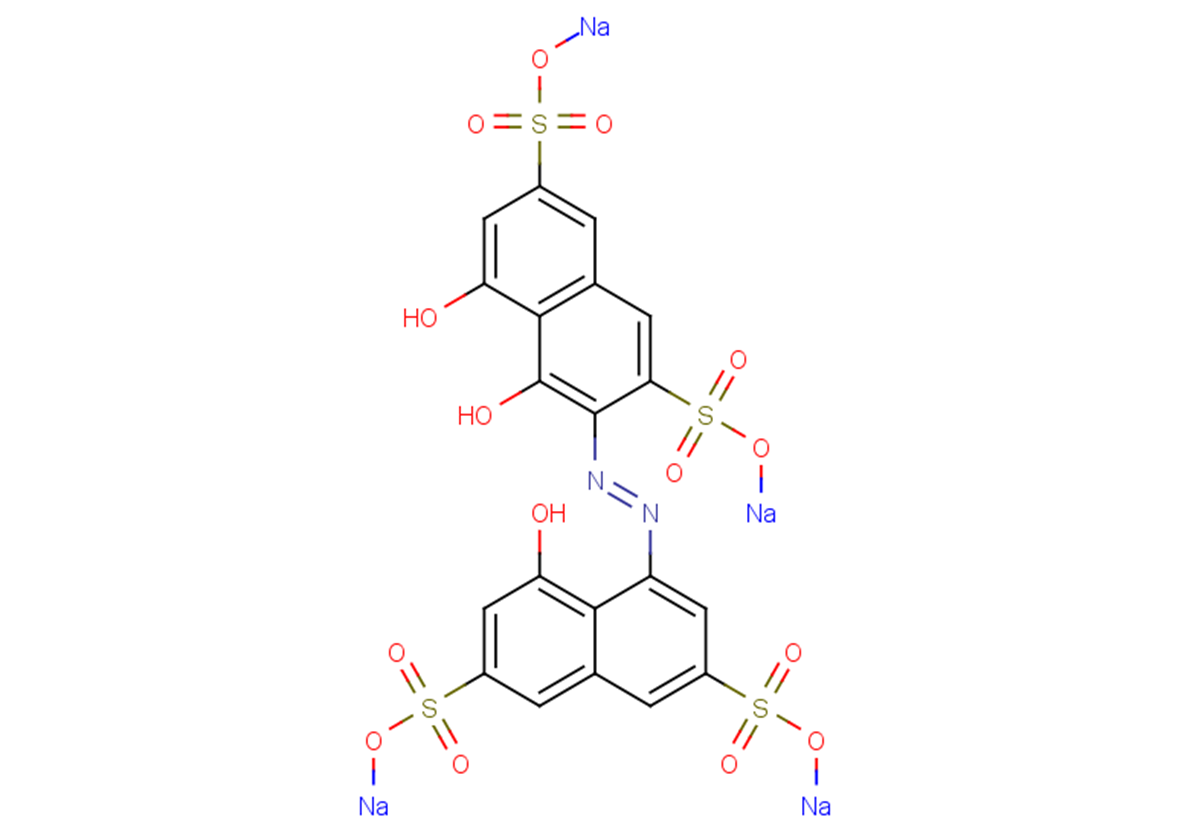
Beryllon II
CAS No. 51550-25-5
Beryllon II( —— )
Catalog No. M24485 CAS No. 51550-25-5
Beryllon II is a widely used chromogenic reagent that is used to determine proteins and many elements, such as Mg, Mo, and Co.
Purity : >98% (HPLC)
 COA
Datasheet
HNMR
HPLC
MSDS
Handing Instructions
COA
Datasheet
HNMR
HPLC
MSDS
Handing Instructions
| Size | Price / USD | Stock | Quantity |
| 1 mL x 10 mM in DMSO | 28 | In Stock |


|
| 100MG | Get Quote | In Stock |
|
| 200MG | 27 | In Stock |
|
| 500MG | Get Quote | In Stock |
|
| 1G | Get Quote | In Stock |
|
Biological Information
-
Product NameBeryllon II
-
NoteResearch use only, not for human use.
-
Brief DescriptionBeryllon II is a widely used chromogenic reagent that is used to determine proteins and many elements, such as Mg, Mo, and Co.
-
DescriptionBeryllon II is a widely used chromogenic reagent that is used to determine proteins and many elements, such as Mg, Mo, and Co.
-
In VitroBeryllon II is a widely used chromogenic reagent that has been used to determine many elements, such as Mo, Mg and Co. Beryllon II-Al3+ complex with the addition of protein can potently enhance the Rayleigh light scattering, and used to determine proteins.
-
In Vivo——
-
Synonyms——
-
PathwayOthers
-
TargetOther Targets
-
Recptorothers
-
Research Area——
-
Indication——
Chemical Information
-
CAS Number51550-25-5
-
Formula Weight738.52
-
Molecular FormulaC20H10N2Na4O15S4
-
Purity>98% (HPLC)
-
SolubilityDMSO:60 mg/mL (80 mM)
-
SMILESOC1=C(C(/N=N/C2=C(O)C(C(O)=CC(S(=O)(O[Na])=O)=C3)=C3C=C2S(=O)(O[Na])=O)=CC(S(=O)(O[Na])=O)=C4)C4=CC(S(=O)(O[Na])=O)=C1
-
Chemical Name——
Shipping & Storage Information
-
Storage(-20℃)
-
ShippingWith Ice Pack
-
Stability≥ 2 years
Reference
1.Dong L, et al. Study of the reaction of proteins with Beryllon II-AlIII by the Rayleigh light scattering technique and its application. Analyst. 2001 May;126(5):707-11.
molnova catalog



related products
-
Cephalonium
Cefalonium (INN) is a first-generation cephalosporin antibiotic.
-
(Phe13,Tyr19)-MCH (h...
(Phe13,Tyr19)-MCH (human, mouse, rat) is a potent SLC-1 and S643b receptor ligand. (Phe13,Tyr19)-MCH (human, mouse, rat) can be used as an agonist for SLC-1 and S643b receptor.
-
Jionoside A1
Jionoside A1 is isolated and purified from the roots of Rehmannia glutinosa.
