


 Cart
Cart
 sales@molnova.com


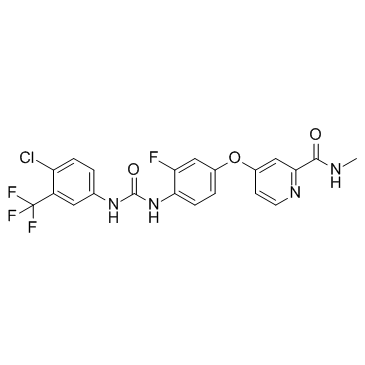
Regorafenib
CAS No. 755037-03-7
Regorafenib( BAY 73-4506 | BAY73-4506 )
Catalog No. M15869 CAS No. 755037-03-7
A potent multikinase inhibitor that potently inhibits these endothelial cell kinases in biochemical and cellular kinase phosphorylation assays with nanomolar range (IC50=3-200 nM).
Purity : >98% (HPLC)
 COA
Datasheet
HNMR
HPLC
MSDS
Handing Instructions
COA
Datasheet
HNMR
HPLC
MSDS
Handing Instructions
| Size | Price / USD | Stock | Quantity |
| 1 mL x 10 mM in DMSO | 49 | In Stock |


|
| 5MG | 29 | In Stock |
|
| 10MG | 45 | In Stock |
|
| 25MG | 69 | In Stock |
|
| 50MG | 90 | In Stock |
|
| 100MG | 137 | In Stock |
|
| 200MG | 181 | In Stock |
|
| 500MG | 303 | In Stock |
|
| 1G | Get Quote | In Stock |
|
Biological Information
-
Product NameRegorafenib
-
NoteResearch use only, not for human use.
-
Brief DescriptionA potent multikinase inhibitor that potently inhibits these endothelial cell kinases in biochemical and cellular kinase phosphorylation assays with nanomolar range (IC50=3-200 nM).
-
DescriptionA potent multikinase inhibitor that potently inhibits these endothelial cell kinases in biochemical and cellular kinase phosphorylation assays with nanomolar range (IC50=3-200 nM); inhibits VEGFR1/2/3, PDGFRβ, FGFR1, KIT, RET and B-RAF etc.; exhibits potent dose-dependent TGI in various preclinical human xenograft models in mice; orally active.Colon Cancer Approved(In Vitro):Regorafenib (0-10 μM, 96 h) shows anti-proliferation activity in GIST 882, Thyroid TT, MDA-MB-231, HepG2, A375 and SW620 cells.Regorafenib (0-3000 nM, 30 min) inhibits the autophosphorylation of VEGFR2, TIE2 and PDGFR-β, and inhibits FGFR and pERK1/2.Regorafenib causes a concentration-dependent decrease in Hep3B cell growth, with an IC50 of 5 μM. Regorafenib subsequently increases the levels of phospho-c-Jun, a JNK target, but not total c-Jun in Hep3B cells.(In Vivo):Regorafenib (10 mg/kg, Orally, single dose or daily for 4 days) inhibits tumor vasculature and tumor growth in a rat GS9L glioblastoma model.Regorafenib (0-100 mg/kg, Orally, qd × 9) exhibits antitumorigenic and antiangiogenic effects in the Colo-205, MDA-MB-231 and 786-O model.
-
In VitroRegorafenib (0-10 μM, 96 h) shows anti-proliferation activity in GIST 882, Thyroid TT, MDA-MB-231, HepG2, A375 and SW620 cells.Regorafenib (0-3000 nM, 30 min) inhibits the autophosphorylation of VEGFR2, TIE2 and PDGFR-β, and inhibits FGFR and pERK1/2.Regorafenib causes a concentration-dependent decrease in Hep3B cell growth, with an IC50 of 5 μM. Regorafenib subsequently increases the levels of phospho-c-Jun, a JNK target, but not total c-Jun in Hep3B cells. Cell Proliferation Assay Cell Line:GIST 882, Thyroid TT, MDA-MB-231, HepG2, A375 and SW620 cells Concentration:10 μM and 5 nM Incubation Time:96 h Result:Showed anti-proliferation activity in GIST 882, Thyroid TT, MDA-MB-231, HepG2, A375 and SW620 cells, with IC50 values of 45 ± 20, 34 ± 8, 401 ± 88, 560 ± 200, 900, 967 ± 287 nM. respectively.Western Blot Analysis Cell Line:NIH-3T3/VEGFR2 cells, (CHO)-TIE2 cells, HAoSMCs cells, MCF-7 cells Concentration:0, 10, 30, 100, 300, 1000, 3000 nM Incubation Time:30 min Result:Inhibited the autophosphorylation of VEGFR2, TIE2 and PDGFR-β, with IC50 values of 3, 31, and 90 nM, respectively, inhibited FGFR signaling in MCF-7 breast cancer (BC) cells stimulated with FGF10, and showed inhibition of phosphorylated FGFR substrate 2 (pFRS2) and the downstream signaling kinase pERK1/2.
-
In VivoRegorafenib (10 mg/kg, Orally, single dose or daily for 4 days) inhibits tumor vasculature and tumor growth in a rat GS9L glioblastoma model.Regorafenib (0-100 mg/kg, Orally, qd × 9) exhibits antitumorigenic and antiangiogenic effects in the Colo-205, MDA-MB-231 and 786-O model. Animal Model:Rat GS9L glioblastoma xenograft Dosage:10 mg/kg Administration:Orally, single dose or daily for 4 days Result:Inhibited tumor vasculature and tumor growth in a rat GS9L glioblastoma model.Animal Model:Female athymic NCr nu/nu mice, Multiple xenograft models, including models derived from CRC (Colo-205), BC (MDA-MB-231) and RCC (786-O) tumors Dosage:0, 3, 10, 30, 100 mg/kg Administration:Orally, qd × 9 Result:Effectively inhibited growth of the Colo-205, MDA-MB-231 and 786-O model. Significantly reduces tumor MVA, effectively inhibited the RAF/MEK/ERK signaling cascade, and drastically inhibited tumor cell proliferation.
-
SynonymsBAY 73-4506 | BAY73-4506
-
PathwayAngiogenesis
-
TargetVEGFR
-
RecptorKit|Raf-1|RET|VEGFR1|VEGFR2|B-Raf(V600E)
-
Research AreaCancer
-
IndicationColon Cancer
Chemical Information
-
CAS Number755037-03-7
-
Formula Weight482.8154
-
Molecular FormulaC21H15ClF4N4O3
-
Purity>98% (HPLC)
-
SolubilityDMSO: ≥ 260 mg/mL
-
SMILESC12=NC(NC3=CC=C(N4CCOCC4)C=C3)=NC(NC5CCCCC5)=C1NC=N2
-
Chemical Name2-Pyridinecarboxamide, 4-[4-[[[[4-chloro-3-(trifluoromethyl)phenyl]amino]carbonyl]amino]-3-fluorophenoxy]-N-methyl-
Shipping & Storage Information
-
Storage(-20℃)
-
ShippingWith Ice Pack
-
Stability≥ 2 years
Reference
1. Wilhelm SM, et al. Int J Cancer. 2011 Jul 1;129(1):245-55.
2. Mross K, et al. Clin Cancer Res. 2012 May 1;18(9):2658-67.
3. Abou-Elkacem L, et al. Mol Cancer Ther. 2013 Jul;12(7):1322-31.
molnova catalog



related products
-
Motesanib
A potent, orally bioavailable, multikinase inhibitor inhibitor of VEGFR1/2/3, PDGFR and c-Kit with IC50 of 2-6 nM, 84 nM and 8 nM, respectively.
-
Telatinib
An orally active, small molecule inhibitor of VEGFR-2 (IC50=6 nM), VEGFR-3 (IC50=4 nM), PDEGFRα (IC50=15 nM) and c-Kit (IC50=1 nM) in biochemical assays.
-
Fargesin
Fargesin as a potential β1AR antagonist through cAMP/PKA pathway could protect against myocardial ischemia/reperfusion injury in rats.
