


 Cart
Cart
 sales@molnova.com


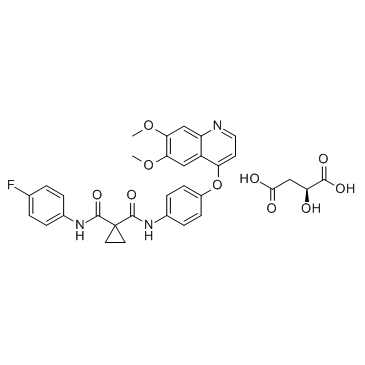
Cabozantinib (S-malate)
CAS No. 1140909-48-3
Cabozantinib (S-malate)( XL184 | XL-184 | Cabozantinib | XL 184 )
Catalog No. M10498 CAS No. 1140909-48-3
Cabozantinib (XL184) is a potent, multi-kinase inhibitor that inhibits VEGFR2, c-Met, Kit, Axl and Flt3 with IC50 of 0.035, 1.3, 4.6, 7 and 11.3 nM, respectively.
Purity : >98% (HPLC)
 COA
Datasheet
HNMR
HPLC
MSDS
Handing Instructions
COA
Datasheet
HNMR
HPLC
MSDS
Handing Instructions
| Size | Price / USD | Stock | Quantity |
| 1 mL x 10 mM in DMSO | 53 | In Stock |


|
| 5MG | 38 | In Stock |
|
| 10MG | 53 | In Stock |
|
| 50MG | 68 | In Stock |
|
| 100MG | 91 | In Stock |
|
| 200MG | 145 | In Stock |
|
| 500MG | 291 | In Stock |
|
| 1G | Get Quote | In Stock |
|
Biological Information
-
Product NameCabozantinib (S-malate)
-
NoteResearch use only, not for human use.
-
Brief DescriptionCabozantinib (XL184) is a potent, multi-kinase inhibitor that inhibits VEGFR2, c-Met, Kit, Axl and Flt3 with IC50 of 0.035, 1.3, 4.6, 7 and 11.3 nM, respectively.
-
DescriptionCabozantinib (XL184) is a potent, multi-kinase inhibitor that inhibits VEGFR2, c-Met, Kit, Axl and Flt3 with IC50 of 0.035, 1.3, 4.6, 7 and 11.3 nM, respectively; eliminates tumor vasculature, reduces pericytes and empty basement membrane sleeves, causes widespread intratumoral hypoxia and tumor cell apoptosis, and slows regrowth of the tumor vasculature, also decreases invasiveness of primary tumors and reduces metastasis in pancreatic islet cancer; exerts marked anti-MPNST effects in vitro and in vivo.Kidney Cancer Approved(In Vitro):Cabozantinib (0.1-0.5μM) inhibits the constitutive and inducible MET phosphorylation and its resultant downstream signaling in all MPNST cells. Cabozantinib (> 0.1μM) elicits a significant MPNST cell growth inhibition; higher Cabozantinib doses are needed to inhibit NSC growth. Cabozantinib treatment blocks HGF-induced MPNST motility and invasion (a similar effect of found on NSC). In cellular assays, cabozantinib inhibits phosphorylation of MET and VEGFR2, as well as KIT, FLT3, and AXL with IC50 values of 7.8, 1.9, 5.0, 7.5, and 42 μM, respectively. Cabozantinib also inhibits tubule formation in response to conditioned media derived from cultures of MDA-MB-231 (IC50=5.1 nM), A431 (IC50=4.1 nM), HT1080 (IC50=7.7 nM), and B16F10 (IC50=4.7 nM) cells. (In Vivo):Cabozantinib (60 mg/kg, i.p.) decreases the tumor vascularity with reductions ranging from 67% at 3 mg/kg to 83% at 30 mg/kg for 7 days in animals. Tumors in RIP-Tag2 mice treated for 7 days beginning at age 10 weeks are 40% smaller after XL880 and 35% smaller after Cabozantinib, compared to corresponding values for vehicle. Cabozantinib (30 mg/kg) significantly decreases the microvessel density in mice. Cabozantinib (100 mg/kg, p.o.) inhibits in vivo stimulation of MET phosphorylation by HGF in liver hepatocytes and VEGF-stimulated phosphorylation of FLK1 with inhibition of both targets sustained through 8 hours postdose. Cabozantinib (100 mg/kg, p.o.) disrupts tumor vasculature and promotes tumor and endothelial cell death. Cabozantinib (1-60 mg/kg, p.o.) inhibits tumor growth and promotes tumor regression in vivo.
-
In Vitro——
-
In Vivo——
-
SynonymsXL184 | XL-184 | Cabozantinib | XL 184
-
PathwayAngiogenesis
-
TargetVEGFR
-
RecptorAXL|c-Met|Kit|VEGFR2/KDR|VEGFR3/FLT4
-
Research AreaCancer
-
IndicationKidney Cancer
Chemical Information
-
CAS Number1140909-48-3
-
Formula Weight635.5931
-
Molecular FormulaC32H30FN3O10
-
Purity>98% (HPLC)
-
SolubilityDMSO: ≥ 23 mg/mL
-
SMILESCOC1=CC2=C(C=CN=C2C=C1OC)OC3=CC=C(C=C3)NC(=O)C4(CC4)C(=O)NC5=CC=C(C=C5)F.C([C@@H](C(=O)O)O)C(=O)O
-
Chemical NameButanedioic acid, 2-hydroxy-, (2S)-, compd. with N-[4-[(6,7-dimethoxy-4-quinolinyl)oxy]phenyl]-N'-(4-fluorophenyl)-1,1-cyclopropanedicarboxamide (1:1)
Shipping & Storage Information
-
Storage(-20℃)
-
ShippingWith Ice Pack
-
Stability≥ 2 years
Reference
1. You WK, et al. Cancer Res. 2011 Jul 15;71(14):4758-68.
2. Durante C, et al. Expert Opin Investig Drugs. 2011 Mar;20(3):407-413.
3. Torres KE, et al. Clin Cancer Res. 2011 Jun 15;17(12):3943-55.
4. Kurzrock R, et al. J Clin Oncol. 2011 Jul 1;29(19):2660-6.
molnova catalog



related products
-
Oglufanide
Oglufanide is a naturally occurring thymic immunomodulatorand inhibits vascular endothelial growth factor (VEGF).
-
VEGFR-3-IN-1
VEGFR-3-IN-1 is a novel, potent, and selective VEGFR3 inhibitor with an IC50 of 110.4 nM.
-
Nintedanib esylate
Nintedanib esylate (BIBF1120 esylate) is a potent triple angiokinase (VEGFR/PDGFR/FGFR) inhibitor.
