


 Cart
Cart
 sales@molnova.com


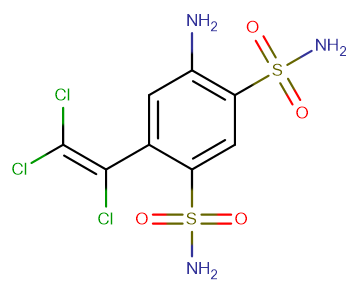
Clorsulon
CAS No. 60200-06-8
Clorsulon( —— )
Catalog No. M15244 CAS No. 60200-06-8
Clorsulon is used in the treatment of Fasciola hepatica infections in calves and sheep.
Purity : >98% (HPLC)
 COA
Datasheet
HNMR
HPLC
MSDS
Handing Instructions
COA
Datasheet
HNMR
HPLC
MSDS
Handing Instructions
| Size | Price / USD | Stock | Quantity |
| 1 mL x 10 mM in DMSO | 37 | In Stock |


|
| 100MG | 33 | In Stock |
|
| 200MG | Get Quote | In Stock |
|
| 500MG | 81 | In Stock |
|
| 1G | Get Quote | In Stock |
|
Biological Information
-
Product NameClorsulon
-
NoteResearch use only, not for human use.
-
Brief DescriptionClorsulon is used in the treatment of Fasciola hepatica infections in calves and sheep.
-
DescriptionClorsulon is used in the treatment of Fasciola hepatica infections in calves and sheep.
-
In Vitro——
-
In Vivo——
-
Synonyms——
-
PathwayOthers
-
TargetOther Targets
-
RecptorOthers
-
Research AreaInfection
-
Indication——
Chemical Information
-
CAS Number60200-06-8
-
Formula Weight380.66
-
Molecular FormulaC8H8Cl3N3O4S2
-
Purity>98% (HPLC)
-
SolubilityEthanol: 7 mg/mL (18.38 mM); DMSO: 76 mg/mL (199.65 mM)
-
SMILESNC1=C(C=C(C(=C1)C(Cl)=C(Cl)Cl)S(N)(=O)=O)S(N)(=O)=O
-
Chemical Name——
Shipping & Storage Information
-
Storage(-20℃)
-
ShippingWith Ice Pack
-
Stability≥ 2 years
Reference
1.Mrozik H, et al. J Med Chem, 1977, 20(9), 1225-1227.
molnova catalog



related products
-
R-E-D-V
REDV is the minimal active sequence within the CS5 site of the alternatively spliced type III connecting segment (IIICS) region of fibronectin. REDV can mediate adhesion to the IIICS region of plasma fibronectin by binding the integrin alpha 4 beta 1(α4β1). REDV can be used for the research of cell adhesion.
-
19-Oxocinobufotalin
19-Oxocinobufotalin 3-adipoylarginine ester shows significant inhibition effect against human hepatocellular carcinoma cell line SMMC-7721 in vitro.
-
Arvenin III
Arvenin III is a useful organic compound for research related to life sciences.
