


 Cart
Cart
 sales@molnova.com


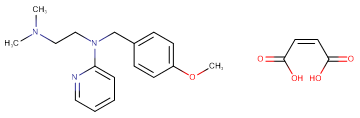
Pyrilamine maleate
CAS No. 59-33-6
Pyrilamine maleate( NSC 3604 | Pyrilamine )
Catalog No. M15200 CAS No. 59-33-6
A histamine H1 antagonist. It has mild hypnotic properties and some local anesthetic action and is used for allergies (including skin eruptions) both parenterally and locally.
Purity : >98% (HPLC)
 COA
Datasheet
HNMR
HPLC
MSDS
Handing Instructions
COA
Datasheet
HNMR
HPLC
MSDS
Handing Instructions
| Size | Price / USD | Stock | Quantity |
| 1 mL x 10 mM in DMSO | 28 | In Stock |


|
| 100MG | Get Quote | In Stock |
|
| 200MG | Get Quote | In Stock |
|
| 500MG | 51 | In Stock |
|
| 1G | 73 | In Stock |
|
Biological Information
-
Product NamePyrilamine maleate
-
NoteResearch use only, not for human use.
-
Brief DescriptionA histamine H1 antagonist. It has mild hypnotic properties and some local anesthetic action and is used for allergies (including skin eruptions) both parenterally and locally.
-
DescriptionA histamine H1 antagonist. It has mild hypnotic properties and some local anesthetic action and is used for allergies (including skin eruptions) both parenterally and locally. It is a common ingredient of cold remedies. (In Vitro):Mepyramine maleate is an antagonist of histamine H1 receptor, with Kds of 0.8 nM, 5200 nM and >3000 nM for H1, H2, and H3 receptor, respectively, and a pKd of 9.4 for H1 receptor. Mepyramine binds to the H1 receptor with different Kds in Guinea pig brain (0.8 nM), rat brain (9.1 nM) and DDT1-MF-2 and BC3H1 cell (276 nM). Mepyramine decreases the InsP levels in CHO-gpH1 cells, with log EC50 of -7.94 ± 0.11, and reduces the the maximal response to ATP in CHO-gpH1 cells.(In Vivo):Mepyramine obviously decreases the second phase of nociceptive response via i.p at 10 and 20 mg/kg, but shows no significant effect at 5 mg/kg in rats.
-
In VitroMepyramine maleate is an antagonist of histamine H1 receptor, with Kds of 0.8 nM, 5200 nM and >3000 nM for H1, H2, and H3 receptor, respectively, and a pKd of 9.4 for H1 receptor. Mepyramine binds to the H1 receptor with different Kds in Guinea pig brain (0.8 nM), rat brain (9.1 nM) and DDT1-MF-2 and BC3H1 cell (276 nM). Mepyramine decreases the InsP levels in CHO-gpH1 cells, with log EC50 of -7.94 ± 0.11, and reduces the the maximal response to ATP in CHO-gpH1 cells.
-
In VivoMepyramine obviously decreases the second phase of nociceptive response via i.p at 10 and 20 mg/kg, but shows no significant effect at 5 mg/kg in rats.
-
SynonymsNSC 3604 | Pyrilamine
-
PathwayGPCR/G Protein
-
TargetHistamine Receptor
-
RecptorH1 receptor
-
Research AreaOther Indications
-
Indication——
Chemical Information
-
CAS Number59-33-6
-
Formula Weight401.47
-
Molecular FormulaC21H27N3O5
-
Purity>98% (HPLC)
-
SolubilitySoluble in DMSO
-
SMILESCN(C)CCN(CC1=CC=C(C=C1)OC)C2=CC=CC=N2.C(=C\C(=O)O)\C(=O)O
-
Chemical Name——
Shipping & Storage Information
-
Storage(-20℃)
-
ShippingWith Ice Pack
-
Stability≥ 2 years
Reference
1.Moriyama K, et al. Inflamm Res. 2009 Dec;58(12):873-80.
molnova catalog



related products
-
Orphenadrine hydroch...
Orphenadrine is an anticholinergic drug of the ethanolamine antihistamine class with prominent central nervous system (CNS) and peripheral actions used to treat painful muscle spasms and other similar conditions, as well as the treatment of some aspects of Parkinson's disease.
-
BMY 25368 HCl
BMY 25368 HCl is a competitive histamine H2 receptor antagonist that antagonizes gastric secretion stimulated by pentagastrin, ethacrynic choline, and food.
-
Enerisant
Enerisant (TS-091) is an orally active, selective and potent histamine H3 receptor antagonist that modulates histamine H3 receptors in mice in a dose-dependent manner.
