


 Cart
Cart
 sales@molnova.com


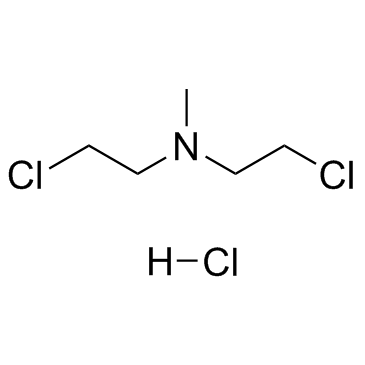
Mechlorethamine hydrochloride
CAS No. 55-86-7
Mechlorethamine hydrochloride( —— )
Catalog No. M15032 CAS No. 55-86-7
Mechlorethamine hydrochloride is a vesicant and necrotizing irritant destructive to mucous membranes.
Purity : >98% (HPLC)
 COA
Datasheet
HNMR
HPLC
MSDS
Handing Instructions
COA
Datasheet
HNMR
HPLC
MSDS
Handing Instructions
| Size | Price / USD | Stock | Quantity |
| 100MG | Get Quote | In Stock |


|
| 200MG | Get Quote | In Stock |
|
| 500MG | Get Quote | In Stock |
|
| 1G | Get Quote | In Stock |
|
Biological Information
-
Product NameMechlorethamine hydrochloride
-
NoteResearch use only, not for human use.
-
Brief DescriptionMechlorethamine hydrochloride is a vesicant and necrotizing irritant destructive to mucous membranes.
-
DescriptionMechlorethamine hydrochloride is a vesicant and necrotizing irritant destructive to mucous membranes.
-
In Vitro——
-
In Vivo——
-
Synonyms——
-
PathwayCell Cycle/DNA Damage
-
TargetDNA/RNA Synthesis
-
RecptorDNA/RNA Synthesis
-
Research AreaCancer
-
Indication——
Chemical Information
-
CAS Number55-86-7
-
Formula Weight192.51
-
Molecular FormulaC5H12Cl3N
-
Purity>98% (HPLC)
-
SolubilityEthanol: 39 mg/mL (202.58 mM); Water: 39 mg/mL (202.58 mM); DMSO: 39 mg/mL (202.58 mM)
-
SMILESCl.CN(CCCl)CCCl
-
Chemical Name——
Shipping & Storage Information
-
Storage(-20℃)
-
ShippingWith Ice Pack
-
Stability≥ 2 years
Reference
1.Khan S, et al. Biochem Pharmacol, 1992, 43(9), 1963-1967.
molnova catalog



related products
-
NCGC00029283
NCGC00029283 is a potent inhibitor of Werner syndrome helicase-nuclease (WRN), displaying inhibitory activity against WRN helicase with an IC 50 value of 2.3 μM.
-
VVD-214
VVD-214 (RO7589831) is a WRN deconjugating enzyme lethal variant inhibitor with potential antitumor activity, inhibits ATP hydrolysis and deconjugating enzyme activity, and can be used in the study of proliferative diseases.
-
Nedaplatin
Nedaplatin is a derivative of cisplatin and DNA damage agent for tumor colony forming units with IC50 of 94 μM.
