


 Cart
Cart
 sales@molnova.com


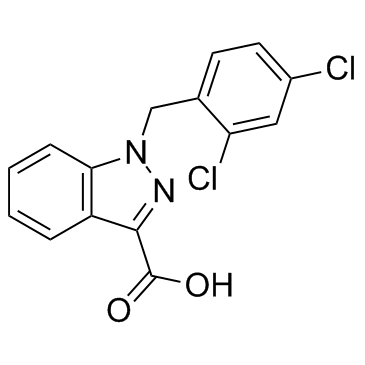
Lonidamine
CAS No. 50264-69-2
Lonidamine( AF 1890 | DICA | Diclondazolic Acid )
Catalog No. M14699 CAS No. 50264-69-2
Lonidamine is an orally administered small molecule hexokinase inactivator.
Purity : >98% (HPLC)
 COA
Datasheet
HNMR
HPLC
MSDS
Handing Instructions
COA
Datasheet
HNMR
HPLC
MSDS
Handing Instructions
| Size | Price / USD | Stock | Quantity |
| 1 mL x 10 mM in DMSO | 48 | In Stock |


|
| 2MG | 31 | In Stock |
|
| 5MG | 43 | In Stock |
|
| 10MG | 55 | In Stock |
|
| 25MG | 71 | In Stock |
|
| 50MG | 109 | In Stock |
|
| 100MG | 141 | In Stock |
|
| 200MG | Get Quote | In Stock |
|
| 500MG | 347 | In Stock |
|
| 1G | 516 | In Stock |
|
Biological Information
-
Product NameLonidamine
-
NoteResearch use only, not for human use.
-
Brief DescriptionLonidamine is an orally administered small molecule hexokinase inactivator.
-
DescriptionLonidamine is an orally administered small molecule hexokinase inactivator.(In Vitro):Lonidamine (100 μM, 24 h) inhibits TGF-β-stimulated lactate production and oxygen consumption rate in AKR-2B and TIG-1 cells.Lonidamine (100 μM, 24/48 h) inhibits H2030BrM3 and A549 cell proliferation.Lonidamine (100-200 μM, 24 h) inhibits H2030BrM3 and A549 cell invasion.Lonidamine (100-1000 μM, 24 h) inhibits mitochondrial complex I and II activities.Lonidamine (200 μM, 24 h) increases ROS generation in H2030BrM3 lung cancer cells.(In Vivo):Lonidamine (oral administration, 10-100 mg/kg/day, d10 to d20) improves lung function by inhibiting hexokinase 2 (HK2) activity in BLM-induced pulmonary fibrosis murine model.
-
In VitroLonidamine (100 μM, 24 h) inhibits TGF-β-stimulated lactate production and oxygen consumption rate in AKR-2B and TIG-1 cells.Lonidamine (100 μM, 24/48 h) inhibits H2030BrM3 and A549 cell proliferation.Lonidamine (100-200 μM, 24 h) inhibits H2030BrM3 and A549 cell invasion.Lonidamine (100-1000 μM, 24 h) inhibits mitochondrial complex I and II activities.Lonidamine (200 μM, 24 h) increases ROS generation in H2030BrM3 lung cancer cells.
-
In VivoLonidamine (oral administration, 10-100 mg/kg/day, d10 to d20) improves lung function by inhibiting hexokinase 2 (HK2) activity in BLM-induced pulmonary fibrosis murine model. Animal Model:Lonidamine (oral administration, 10-100 mg/kg/day, d10 to d20) improves lung function by inhibiting hexokinase 2 (HK2) activity in BLM-induced pulmonary fibrosis murine model.Dosage:10, 30, 100 mg/kg/day Administration:Oral administration, daily, d10 to d20 after BLM treatment.Result:Partially or completely reversed the increases in HK2 and lactate induced by BLM and reduced the expression of 10 profibrotic mediators.
-
SynonymsAF 1890 | DICA | Diclondazolic Acid
-
PathwayOthers
-
TargetOther Targets
-
Recptorhexokinase
-
Research AreaCancer
-
Indication——
Chemical Information
-
CAS Number50264-69-2
-
Formula Weight321.17
-
Molecular FormulaC15H10Cl2N2O2
-
Purity>98% (HPLC)
-
SolubilityDMSO: 64 mg/mL (199.27 mM)
-
SMILESO=C(C1=NN(CC2=CC=C(Cl)C=C2Cl)C3=C1C=CC=C3)O
-
Chemical Name1-(2,4-dichlorobenzyl)-1H-indazole-3-carboxylic acid
Shipping & Storage Information
-
Storage(-20℃)
-
ShippingWith Ice Pack
-
Stability≥ 2 years
Reference
1.Floridi A, et al. J Natl Y Inst, 1981, 66(3), 497-499.
molnova catalog



related products
-
PAOPA
dopamine D2 receptor modulator
-
LOC14
LOC14 to be the most potent PDI inhibitor reported to date( EC50 : 500 nM).
-
Momordicin II
Triterpenoids
