


 Cart
Cart
 sales@molnova.com


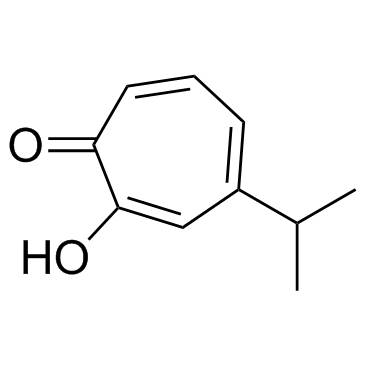
Hinokitiol
CAS No. 499-44-5
Hinokitiol( 4-Isopropyltropolone | β-Thujaplicin )
Catalog No. M14672 CAS No. 499-44-5
Hinokitiol (4-Isopropyltropolone;β-Thujaplicin) is a tropolone-related natural compound that can induces apoptosis and cell cycle arrest.
Purity : >98% (HPLC)
 COA
Datasheet
HNMR
HPLC
MSDS
Handing Instructions
COA
Datasheet
HNMR
HPLC
MSDS
Handing Instructions
| Size | Price / USD | Stock | Quantity |
| 1 mL x 10 mM in DMSO | 33 | In Stock |


|
| 50MG | 29 | In Stock |
|
| 100MG | 52 | In Stock |
|
| 200MG | Get Quote | In Stock |
|
| 500MG | 75 | In Stock |
|
| 1G | 91 | In Stock |
|
Biological Information
-
Product NameHinokitiol
-
NoteResearch use only, not for human use.
-
Brief DescriptionHinokitiol (4-Isopropyltropolone;β-Thujaplicin) is a tropolone-related natural compound that can induces apoptosis and cell cycle arrest.
-
DescriptionHinokitiol (4-Isopropyltropolone;β-Thujaplicin) is a tropolone-related natural compound that can induces apoptosis and cell cycle arrest, exhibits anti-inflammatory and anti-tumor activities; inhibits the proliferation of Chlamydia trachomatis with MIC of 32 ug/mL; also can harness such gradients to restore iron transport into, within, and/or out of cells.
-
In VitroIn U87MG and T98G glioma cell lines, hinokitiol demonstrates a dose-dependent decrease in viability, with IC50 values of 316.5 ± 35.5 and 152.5 ± 25.3 μM, respectively. Hinokitiol represses ALDH activity and self-renewal ability in glioma stem cells, and inhibits in vitro oncogenicity. Hinokitiol also reduces Nrf2 expression in glioma stem cells in a dose-dependent manner. Hinokitiol (0-100 μM) inhibits colon cancer cell growth in a dose- and time-dependent manner. Hinokitiol (5, 10 μM) decreases DNMT1 and UHRF1 mRNA and protein expression, and increases TET1 expression via enhancement of 5hmC level in HCT-116 cells. Furthermore, hinokitiol reduces methylation status and restores mRNA expression of MGMT, CHST10, and BTG4 genes.
-
In Vivo——
-
Synonyms4-Isopropyltropolone | β-Thujaplicin
-
PathwayApoptosis
-
TargetApoptosis
-
RecptorERα
-
Research AreaNeurological Disease
-
Indication——
Chemical Information
-
CAS Number499-44-5
-
Formula Weight164.204
-
Molecular FormulaC10H12O2
-
Purity>98% (HPLC)
-
SolubilityChloroform: Soluble DMSO: 29 mg/mL (176.6 mM) ( < 1 mg/ml refers to the product slightly soluble or insoluble )
-
SMILESCC(C)C1=CC(=O)C(=CC=C1)O
-
Chemical Name2-hydroxy-4-(1-methylethyl)-2,4,6-cycloheptatrien-1-one
Shipping & Storage Information
-
Storage(-20℃)
-
ShippingWith Ice Pack
-
Stability≥ 2 years
Reference
1. Yamano H, et al. Antimicrob Agents Chemother. 2005 Jun;49(6):2519-21.
2. Seo JS, et al. BMC Cell Biol. 2017 Feb 27;18(1):14.
3. Grillo AS, et al. Science. 2017 May 12;356(6338):608-616.
molnova catalog



related products
-
W146
W146 is a selective and potent Sphingosine 1-phosphate receptor subtype 1 (S1PR1) antagonist that induces significant but transient hematolymphopenia in mice.
-
Mardepodect hydrochl...
Mardepodect hydrochloride (Mardepodect HCl) is an orally active, selective and potent inhibitor of PDE10A that crosses the blood-brain barrier (IC50: 0.37 nM).
-
Polyporenic acid C
Polyporenic acid C shows inhibitory activity against human collagenase.
