


 Cart
Cart
 sales@molnova.com


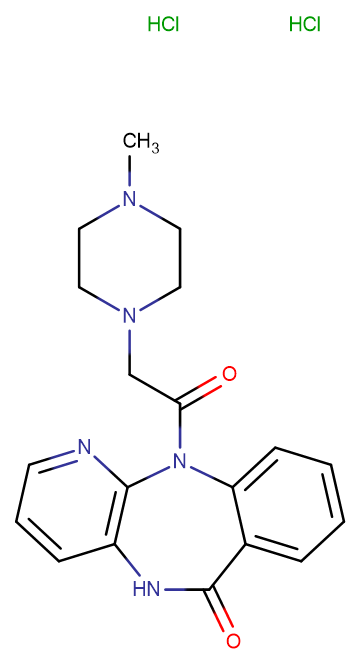
Pirenzepine dihydrochloride
CAS No. 29868-97-1
Pirenzepine dihydrochloride( —— )
Catalog No. M13915 CAS No. 29868-97-1
An antimuscarinic agent that inhibits gastric secretion at lower doses than are required to affect gastrointestinal motility, salivary, central nervous system, cardiovascular, ocular, and urinary function.
Purity : >98% (HPLC)
 COA
Datasheet
HNMR
HPLC
MSDS
Handing Instructions
COA
Datasheet
HNMR
HPLC
MSDS
Handing Instructions
| Size | Price / USD | Stock | Quantity |
| 100MG | 31 | In Stock |


|
| 200MG | Get Quote | In Stock |
|
| 500MG | 60 | In Stock |
|
| 1G | 86 | In Stock |
|
Biological Information
-
Product NamePirenzepine dihydrochloride
-
NoteResearch use only, not for human use.
-
Brief DescriptionAn antimuscarinic agent that inhibits gastric secretion at lower doses than are required to affect gastrointestinal motility, salivary, central nervous system, cardiovascular, ocular, and urinary function.
-
DescriptionAn antimuscarinic agent that inhibits gastric secretion at lower doses than are required to affect gastrointestinal motility, salivary, central nervous system, cardiovascular, ocular, and urinary function. It promotes the healing of duodenal ulcers and due to its cytoprotective action is beneficial in the prevention of duodenal ulcer recurrence. It also potentiates the effect of other antiulcer agents such as climetidine and panitidine.(In Vitro):Pirenzepine (100-140 μg/mL; 24 h) inhibits PC-3 cell proliferation activity.Pirenzepine (110 μg/mL; 24 h) inhibits prostate and lung cancer cell migration.Pirenzepine (100-130 μg/mL; 0-24 h) inhibits the expression of GLI1 in PC-3 cells.(In Vivo):Pirenzepine (intraperitoneal injection; 0.3 mg/kg; once) treatment shows beneficial effects in lipopolysaccharide-induced septic shock.
-
In VitroPirenzepine (100-140 μg/mL; 24 h) inhibits PC-3 cell proliferation activity.Pirenzepine (110 μg/mL; 24 h) inhibits prostate and lung cancer cell migration.Pirenzepine (100-130 μg/mL; 0-24 h) inhibits the expression of GLI1 in PC-3 cells. Cell Proliferation Assay Cell Line:PC-3 cells Concentration:100-140 μg/mL Incubation Time:24 hours Result:Inhibited PC-3 cell proliferation in a concentration-dependent manner.Cell Migration Assay Cell Line:PC-3 and A549 cells Concentration:110 μg/mL Incubation Time:24 hours Result:Inhibited the migration of PC-3 and A549 cell lines (P=0.014).Cell Migration Assay Cell Line:PC-3 cells Concentration:110 μg/mL Incubation Time:0-24 hours Result:Inhibited the expression of GLI1 and PTCH1.RT-PCR Cell Line:PC-3 cells Concentration:100-130 μg/mL Incubation Time:24 hours Result:Suppressed GLI1 mRNA expression in PC-3 cells. Increased PTCH1 mRNA level but not reach statistical significance.
-
In VivoPirenzepine (intraperitoneal injection; 0.3?mg/kg; once) treatment shows beneficial effects in lipopolysaccharide-induced septic shock. Animal Model:Male C57BL/6 mice with experimental endotoxemia Dosage:0.3?mg/kg Administration:Intraperitoneal injection; 0.3?mg/kg; once Result:Improved survival rate of LPS-induced septic shock.Relieved LPS-induced pulmonary and hepatic injury.Reduced the expression of SOCS3 at mRNA level.
-
Synonyms——
-
PathwayEndocrinology/Hormones
-
TargetAChR
-
RecptormAChR
-
Research AreaNeurological Disease
-
Indication——
Chemical Information
-
CAS Number29868-97-1
-
Formula Weight424.32
-
Molecular FormulaC19H21N5O2·2HCl
-
Purity>98% (HPLC)
-
SolubilityWater: 100 mM
-
SMILESCl.Cl.CN1CCN(CC(=O)N2C3=CC=CC=C3C(=O)NC3=C2N=CC=C3)CC1
-
Chemical Name——
Shipping & Storage Information
-
Storage(-20℃)
-
ShippingWith Ice Pack
-
Stability≥ 2 years
Reference
1.Chen X, et al. Nucleic Acids Res. 2002 Jan 1; 30(1):412-5.
molnova catalog



related products
-
mAChr-in-1
mAChR-IN-1 is muscarinic cholinergic receptor(mAChR) antagonist (IC50=17 nM).
-
Proxyphylline
Proxyphylline is a dual of adenosine A1/A2a receptor inhibitor and phosphodiesterase (PDE) inhibitor. Proxyphylline acts as a cardiac stimulant vasodilator and bronchodilator.
-
Adiphenine hydrochlo...
Adiphenine hydrochloride is a nicotinic receptor inhibitor, used as an antispasmodic drug.
