


 Cart
Cart
 sales@molnova.com


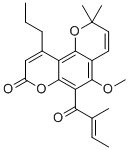
GUT-70
CAS No. 161633-75-6
GUT-70( GUT70 )
Catalog No. M12357 CAS No. 161633-75-6
GUT-70 is a tricyclic coumarin derived from Calophyllum brasiliense, markedly reduces cell proliferation.
Purity : >98% (HPLC)
 COA
Datasheet
HNMR
HPLC
MSDS
Handing Instructions
COA
Datasheet
HNMR
HPLC
MSDS
Handing Instructions
| Size | Price / USD | Stock | Quantity |
| 100MG | Get Quote | Get Quote |


|
| 200MG | Get Quote | Get Quote |
|
| 500MG | Get Quote | Get Quote |
|
| 1G | Get Quote | Get Quote |
|
Biological Information
-
Product NameGUT-70
-
NoteResearch use only, not for human use.
-
Brief DescriptionGUT-70 is a tricyclic coumarin derived from Calophyllum brasiliense, markedly reduces cell proliferation.
-
DescriptionGUT-70 is a tricyclic coumarin derived from Calophyllum brasiliense, markedly reduces cell proliferation, viability through G1 cell cycle arrest and increases apoptosis; shows binding affinity to heat-shock protein 90 (Hsp90) and ubiquitin-dependent proteasomal degradation of Hsp90 client proteins, including cyclin D1, Raf-1, Akt, and mt-p53; also inhibits HIV-1 replication in both acutely and chronically infected cells through suppression of NF-κB.
-
In Vitro——
-
In Vivo——
-
SynonymsGUT70
-
PathwayApoptosis
-
TargetApoptosis
-
RecptorApoptosis
-
Research Area——
-
Indication——
Chemical Information
-
CAS Number161633-75-6
-
Formula Weight382.456
-
Molecular FormulaC23H26O5
-
Purity>98% (HPLC)
-
Solubility——
-
SMILES——
-
Chemical Name2H,8H-Benzo[1,2-b:3,4-b']dipyran-8-one, 5-methoxy-2,2-dimethyl-6-(2-methyl-1-oxo-2-butenyl)-10-propyl-, (E)-
Shipping & Storage Information
-
Storage(-20℃)
-
ShippingWith Ice Pack
-
Stability≥ 2 years
Reference
1. Kimura S, et al. Int J Cancer. 2005 Jan 1;113(1):158-65.
2. Jin L, et al. Br J Cancer. 2011 Jan 4;104(1):91-100.
3. Kudo E, et al. Bioorg Med Chem Lett. 2013 Feb 1;23(3):606-9.
molnova catalog



related products
-
LCH-7749944
LCH-7749944 effectively suppresses the proliferation of human gastric cancer cells through downregulation of PAK4/c-Src/EGFR/cyclin D1 pathway and induces apoptosis.?
-
Resolvin D1
Resolvin D1 (RvD1) is an endogenous pro-inflammatory mediator that blocks pro-inflammatory neutrophil migration by regulating actin polymerization.
-
CSRM617 hydrochlorid...
CSRM617 hydrochloride is a selective small-molecule inhibitor of the transcription factor ONECUT2 (OC2, a master regulator of androgen receptor), with a Kd of 7.43 μM in SPR assays, directly binding to the OC2-HOX domain.
