


 Cart
Cart
 sales@molnova.com


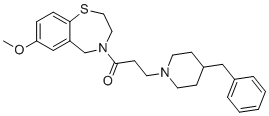
JTV-519
CAS No. 145903-06-6
JTV-519( K201 | JTV519 )
Catalog No. M11979 CAS No. 145903-06-6
JTV-519 (K201) is a Ca2+-dependent blocker of SERCA and a partial agonist of ryanodine receptors (RyRs).
Purity : >98% (HPLC)
 COA
Datasheet
HNMR
HPLC
MSDS
Handing Instructions
COA
Datasheet
HNMR
HPLC
MSDS
Handing Instructions
| Size | Price / USD | Stock | Quantity |
| 5MG | 873 | Get Quote |


|
| 50MG | 1782 | Get Quote |
|
| 100MG | 2250 | Get Quote |
|
| 200MG | Get Quote | Get Quote |
|
| 500MG | Get Quote | Get Quote |
|
| 1G | Get Quote | Get Quote |
|
Biological Information
-
Product NameJTV-519
-
NoteResearch use only, not for human use.
-
Brief DescriptionJTV-519 (K201) is a Ca2+-dependent blocker of SERCA and a partial agonist of ryanodine receptors (RyRs).
-
DescriptionJTV-519 (K201) is a Ca2+-dependent blocker of SERCA and a partial agonist of ryanodine receptors (RyRs); displays Ca(2+)-dependent inhibition of SERCA-dependent ATPase activity with IC50 of 9 uM at 0.25 Ca2+ in cardiac muscle; may prevent abnormal Ca(2+) leak from the sarcoplasmic reticulum (SR) in the ischemic heart and skeletal muscle (SkM) by stabilizing the ryanodine receptors (RyRs; RyR1 and RyR2, respectively).Heart Arrhythmia Phase 2 Discontinued.
-
In VitroJTV-519 (K201) inhibits inward Ca2+ movement into large unilamellar vesicles (LUV) caused by annexin V in a dose-dependent manner. In the presence of 50 nM annexin V and 400 μM Ca2+, 3 μM JTV-519 shows significant inhibition of Ca2+ movement due to annexin V, and 50% inhibition is achieved at 25 μM K201.
-
In VivoJTV-519 (0.5mg/kg/h, i.v., 2 h before the surgery) improves cardiac function in CLP mice, where thefractional shortening (FS) and ejection fraction (EF)are significantly increased as compared with CLP mice without JTV-519 treatment. Animal Model:Wild type male C57BL/6 mice weighing 18-22g with polymicrobial sepsis produced by cecal ligation and puncture (CLP)Dosage:0.5 mg/kg/h Administration:Applied intraperitoneally 2 h before the surgery Result:Improved cardiac function, where the EF and FS were significantly increased.
-
SynonymsK201 | JTV519
-
PathwayGPCR/G Protein
-
TargetCalcium Channel
-
RecptorCalcium Channel
-
Research AreaCardiovascular Disease
-
IndicationHeart Arrhythmia
Chemical Information
-
CAS Number145903-06-6
-
Formula Weight424.603
-
Molecular FormulaC25H32N2O2S
-
Purity>98% (HPLC)
-
Solubility——
-
SMILESCOC1=CC2=C(C=C1)SCCN(C2)C(=O)CCN3CCC(CC3)CC4=CC=CC=C4
-
Chemical Name1-(2,3-Dihydro-7-methoxy-1,4-benzothiazepin-4(5H)-yl)-3-[4-(phenylmethyl)-1-piperidinyl]-1-propanone
Shipping & Storage Information
-
Storage(-20℃)
-
ShippingWith Ice Pack
-
Stability≥ 2 years
Reference
1. Darcy YL, et al. Mol Pharmacol. 2016 Aug;90(2):106-15.
2. Inagaki K, et al. Circulation. 2000 Feb 22;101(7):797-804.
3. Ito K, et al. Br J Pharmacol. 2000 Jun;130(4):767-76.
4. Nakaya H, et al. Br J Pharmacol. 2000 Dec;131(7):1363-72.
molnova catalog



related products
-
Cav 2.2 blocker 1
Cav 2.2 blocker 1 is an N-type calcium channel (Cav 2.2; IC50: 1 nM) blocker for the treatment of pain.
-
Stugeron
Cinnarizine is a drug derivative of piperazine, and characterized as an antihistamine and a calcium channel blocker.
-
CDN1163
CDN1163 (CDN-1163) is a small molecule, allosteric activator of SERCA2.
