


 Cart
Cart
 sales@molnova.com


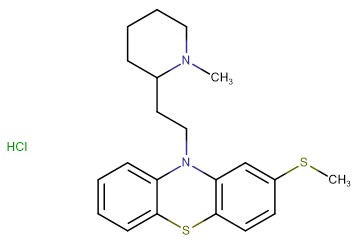
Thioridazine hydrochloride
CAS No. 130-61-0
Thioridazine hydrochloride( Aldazine | Mellaril )
Catalog No. M11223 CAS No. 130-61-0
Thioridazine is an antipsychotic drug, used in the treatment of schizophrenia and psychosis, shows D4 selectivity or serotonin antagonism.
Purity : >98% (HPLC)
 COA
Datasheet
HNMR
HPLC
MSDS
Handing Instructions
COA
Datasheet
HNMR
HPLC
MSDS
Handing Instructions
| Size | Price / USD | Stock | Quantity |
| 1 mL x 10 mM in DMSO | 48 | In Stock |


|
| 50MG | 33 | In Stock |
|
| 100MG | 45 | In Stock |
|
| 200MG | 55 | In Stock |
|
| 500MG | 75 | In Stock |
|
| 1G | Get Quote | In Stock |
|
Biological Information
-
Product NameThioridazine hydrochloride
-
NoteResearch use only, not for human use.
-
Brief DescriptionThioridazine is an antipsychotic drug, used in the treatment of schizophrenia and psychosis, shows D4 selectivity or serotonin antagonism.
-
DescriptionThioridazine is an antipsychotic drug, used in the treatment of schizophrenia and psychosis, shows D4 selectivity or serotonin antagonism.(In Vitro):Thioridazine (0.01-100 μM; 48 h) reduces the cell viability of NCI-N87 and AGS cells in a concentration-dependent manner.Thioridazine (15 μM; 24 h) reduces cell viability of the cervical (HeLa, Caski and C33A) and endometrial (HEC-1-A and KLE) cancer cells.Thioridazine (1-15 μM; 24-48 h) induces gastric cancer cell death via the mitochondrial apoptosis pathway and mitochondrial pathway.Thioridazine (15 μM; 24 h) modulates the regulation of cell cycle progression by interfering with the PI3K/Akt pathway and induces G1 cell cycle arrest in cervical and endometrial cancer cells .Thioridazine inhibits the growth of antibiotic-sensitive and multidrug-resistant strains of A. baumannii.(In Vivo):Thioridazine (25 mg/kg; i.p. every 3 days for 3 weeks) extends the survival of tumor-bearing mice and reduces the number of pluripotent embryonal carcinoma (EC) cells within tumors.Thioridazine (1.0-5.0 mg/kg; s.c.) reduces oral behavior and selectively blocks repetitive head bobbing.
-
In VitroCell Proliferation Assay Cell Line:NCI-N87 and AGS cells Concentration:0.01, 0.1, 0.5, 1, 5, 10, 20, 50, 100 μM.Incubation Time:48 hours Result:Exhibited cytotoxicity in gastric cancer cells.Western Blot Analysis Cell Line:NCI-N87 and AGS cells Concentration:1, 5, 10, 15 μM Incubation Time:24, 48 hours Result:Down regulated the precursors of caspase-9, caspase-8 and caspase-3.
-
In VivoAnimal Model:Nude and Rag2KO mice were injected with iPS cells or NT2D1 cells Dosage:25 mg/kg Administration:I.p. every 3 days for 3 weeks Result:Reduced the number of OCT4-expressing cells within malignant teratocarcinomas and extended the survival of tumor-bearing mice.With no effect on fertility.
-
SynonymsAldazine | Mellaril
-
PathwayEndocrinology/Hormones
-
Target5-HT Receptor
-
Recptor5-HT| Adrenergic Receptor| Dopamine| Potassium Channel
-
Research AreaNeurological Disease
-
Indication——
Chemical Information
-
CAS Number130-61-0
-
Formula Weight407.04
-
Molecular FormulaC21H27ClN2S2
-
Purity>98% (HPLC)
-
SolubilitySoluble in DMSO
-
SMILESCl.CSC1=CC2=C(SC3=CC=CC=C3N2CCC2CCCCN2C)C=C1
-
Chemical Name——
Shipping & Storage Information
-
Storage(-20℃)
-
ShippingWith Ice Pack
-
Stability≥ 2 years
Reference
1.Assie MB, et al. Eur J Pharmacol. 1993 Jun 24;237(2-3):183-9.
molnova catalog



related products
-
BRL-15572 dihydrochl...
BRL-15572 is a potent, selective h5-HT1D receptor antagonist.
-
4-((5-cyclopropyl-3-...
4-((5-cyclopropyl-3-methyl-1-((methylsulfonyl)methyl)-1H-pyrazol-4-yl)oxy)-2,6-dimethylbenzonitrile is an agonist of 5-HT Receptor with anti-Alzheimer and antidepressant activities.
-
Procaine hydrochlori...
A local anesthetic of the ester type that has a slow onset and a short duration of action. It is mainly used for infiltration anesthesia, peripheral nerve block, and spinal block.
