


 Cart
Cart
 sales@molnova.com


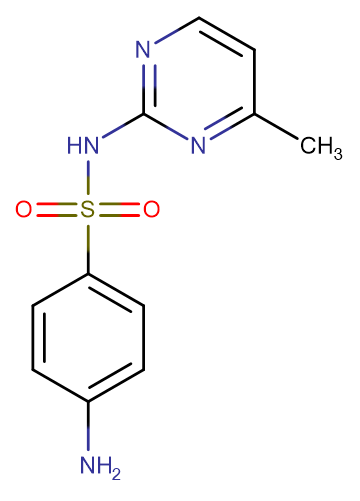
Sulfamerazine
CAS No. 127-79-7
Sulfamerazine( Sulfamerazine | Mebacid | Methylsulfadiazine )
Catalog No. M11153 CAS No. 127-79-7
Sulfamerazine(RP-2632) is a sulfonamide antibacterial.
Purity : >98% (HPLC)
 COA
Datasheet
HNMR
HPLC
MSDS
Handing Instructions
COA
Datasheet
HNMR
HPLC
MSDS
Handing Instructions
| Size | Price / USD | Stock | Quantity |
| 1 mL x 10 mM in DMSO | 48 | In Stock |


|
| 100MG | 28 | In Stock |
|
| 200MG | Get Quote | In Stock |
|
| 500MG | 54 | In Stock |
|
| 1G | 90 | In Stock |
|
Biological Information
-
Product NameSulfamerazine
-
NoteResearch use only, not for human use.
-
Brief DescriptionSulfamerazine(RP-2632) is a sulfonamide antibacterial.
-
DescriptionSulfamerazine(RP-2632) is a sulfonamide antibacterial.(In Vitro):Sulfamerazine is bacteriostatic in nature. Inhibition of dihydrofolic acid synthesis decreases the synthesis of bacterial nucleotides and DNA.
-
In VitroSulfamerazine is bacteriostatic in nature. Inhibition of dihydrofolic acid synthesis decreases the synthesis of bacterial nucleotides and DNA.
-
In Vivo——
-
SynonymsSulfamerazine | Mebacid | Methylsulfadiazine
-
PathwayAutophagy
-
TargetAutophagy
-
RecptorDHPS
-
Research AreaInfection
-
Indication——
Chemical Information
-
CAS Number127-79-7
-
Formula Weight264.3
-
Molecular FormulaC11H12N4O2S
-
Purity>98% (HPLC)
-
SolubilityDMSO: 53 mg/mL (200.52 mM)
-
SMILESO=S(C1=CC=C(N)C=C1)(NC2=NC=CC(C)=N2)=O
-
Chemical Name4-Amino-N-(4-methyl-2-pyrimidinyl)-benzenesulfonamide
Shipping & Storage Information
-
Storage(-20℃)
-
ShippingWith Ice Pack
-
Stability≥ 2 years
Reference
1.Hong YL, et al. Antimicrob Agents ChemOthers. 1995, 39(8):1756-63.
2. Friaza V, et al. Postgrad Med. 2010, 122(6):24-8.
3. Thijssen HH. Anal Biochem. 1973, 53(2):579-85.
4. Rajendiran N, et al. Spectrochim Acta A Mol Biomol Spectrosc, 2014, 124, 441-450.
5. De Backer P, et al. Am J Vet Res, 1982, 43(10), 1744-175
molnova catalog



related products
-
ROC-325
ROC-325 (ROC 325, ROC325) is a novel, orally available inhibitor of lysosomal-mediated autophagy.
-
SR-3677
SR-3677 is an effective and specific inhibitor of ROCK2 (IC50: 3 nM).
-
Ginkgolide K
Ginkgolide K induces protective autophagy through the AMPK/mTOR/ULK1 signalling pathway. It possesses neuroprotective activity.
