


 Cart
Cart
 sales@molnova.com


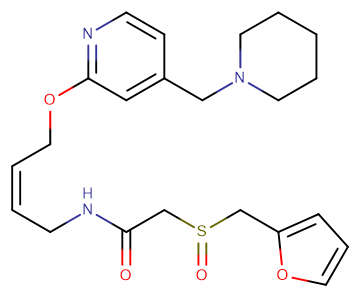
Lafutidine
CAS No. 118288-08-7
Lafutidine( —— )
Catalog No. M10619 CAS No. 118288-08-7
Lafutidine, a newly developed histamine H(2)-receptor antagonist, inhibits gastric acid secretion.
Purity : >98% (HPLC)
 COA
Datasheet
HNMR
HPLC
MSDS
Handing Instructions
COA
Datasheet
HNMR
HPLC
MSDS
Handing Instructions
| Size | Price / USD | Stock | Quantity |
| 1 mL x 10 mM in DMSO | 44 | In Stock |


|
| 25MG | 39 | In Stock |
|
| 50MG | 61 | In Stock |
|
| 100MG | 91 | In Stock |
|
| 200MG | 132 | In Stock |
|
| 500MG | Get Quote | In Stock |
|
| 1G | Get Quote | In Stock |
|
Biological Information
-
Product NameLafutidine
-
NoteResearch use only, not for human use.
-
Brief DescriptionLafutidine, a newly developed histamine H(2)-receptor antagonist, inhibits gastric acid secretion.
-
DescriptionLafutidine, a newly developed histamine H(2)-receptor antagonist, inhibits gastric acid secretion.(In Vitro):Lafutidine exhibits gastric mucosal protective action mediated by capsaicin-sensitive afferent neurons, in addition to a potent antisecretory effect.Lafutidine (0.1-10 μM) significantly augments the periarterial nerve stimulation (PNS, 1 Hz) induced-vasodilation in a concentration-dependent manner in rat perfused mesenteric vascular beds.(In Vivo):Lafutidine (3-30 mg/kg; p.o.; twice daily; for 6 days) dose-dependently reduces the severity of dextran sulfate Na (DSS)-induced colitis and significantly mitigates changes in the colon length and myeloperoxidase (MPO) activity.
-
In VitroLafutidine exhibits gastric mucosal protective action mediated by capsaicin-sensitive afferent neurons, in addition to a potent antisecretory effect.Lafutidine (0.1-10 μM) significantly augments the periarterial nerve stimulation (PNS, 1 Hz) induced-vasodilation in a concentration-dependent manner in rat perfused mesenteric vascular beds.
-
In VivoLafutidine (3-30 mg/kg; p.o.; twice daily; for 6 days) dose-dependently reduces the severity of dextran sulfate Na (DSS)-induced colitis and significantly mitigates changes in the colon length and myeloperoxidase (MPO) activity. Animal Model:Male Wistar rats (180-200 g)Dosage:3 mg/kg, 10 mg/kg, 30 mg/kg Administration:Oral administration, twice daily, for 6 daysResult:Reduced the severity of DSS-induced ulcerative colitis in a dose-dependent manner.
-
Synonyms——
-
PathwayEndocrinology/Hormones
-
Target5-HT Receptor
-
RecptorHT
-
Research AreaMetabolic Disease
-
Indication——
Chemical Information
-
CAS Number118288-08-7
-
Formula Weight431.55
-
Molecular FormulaC22H29N3O4S
-
Purity>98% (HPLC)
-
SolubilityEthanol: 13 mg/mL (30.12 mM); DMSO: 86 mg/mL (199.28 mM)
-
SMILESC1CCN(CC1)CC2=CC(=NC=C2)OC/C=C\CNC(=O)CS(=O)CC3=CC=CO3
-
Chemical Name——
Shipping & Storage Information
-
Storage(-20℃)
-
ShippingWith Ice Pack
-
Stability≥ 2 years
Reference
1.Kim EH, et al. Dig Dis Sci. 2014 Dec 23.
molnova catalog



related products
-
D-Glucuronic acid
Glucuronic Acid?is a carboxylic acid with structural similarity to?glucose?with detoxifying activity.
-
gypenoside A
anticancer
-
Sertraline hydrochlo...
Sertraline hydrochloride is an antidepressant of the selective serotonin reuptake inhibitor (SSRI) class.
