


 Cart
Cart
 sales@molnova.com


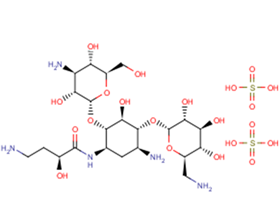
Amikacin disulfate
CAS No. 39831-55-5
Amikacin disulfate( BAY-416651 sulfate )
Catalog No. M18522 CAS No. 39831-55-5
Amikacin sulfate(BAY416651 sulfate) is a semi-synthetic aminoglycoside antibiotic derived from kanamycin A.
Purity : >98% (HPLC)
 COA
Datasheet
HNMR
HPLC
MSDS
Handing Instructions
COA
Datasheet
HNMR
HPLC
MSDS
Handing Instructions
| Size | Price / USD | Stock | Quantity |
| 100MG | Get Quote | In Stock |


|
| 200MG | Get Quote | In Stock |
|
| 500MG | 39 | In Stock |
|
| 1G | 60 | In Stock |
|
Biological Information
-
Product NameAmikacin disulfate
-
NoteResearch use only, not for human use.
-
Brief DescriptionAmikacin sulfate(BAY416651 sulfate) is a semi-synthetic aminoglycoside antibiotic derived from kanamycin A.
-
DescriptionAmikacin sulfate(BAY416651 sulfate) is a semi-synthetic aminoglycoside antibiotic derived from kanamycin A.(In Vitro):Amikacin offers definite advantages for treating infections caused by organisms resistant to other aminoglycosides. Amikaci is affected by relatively few arninoglycoside-modifying enzymes. Amikacin is useful in the treatment of infections caused by Nocardia asteroides, Mycobacterium avium-intracellulare, and certain species of "rapid-growing" mycobacteria (that is, M. chelonae and M. fortuitumi).Amikacin (100-1500 μM) causes a reliable dose-dependent loss of lateral line zebrafish hair cells with a LD50 value of 453 μM.(In Vivo):Amikacin (320 mg/kg; subcutaneous injection; daily; for 10 days; male Fischer rats) treatment increases the chance of serious hearing loss in rats in vivo.
-
In VitroAmikacin offers definite advantages for treating infections caused by organisms resistant to other aminoglycosides. Amikaci is affected by relatively few arninoglycoside-modifying enzymes. Amikacin is useful in the treatment of infections caused by Nocardia asteroides, Mycobacterium avium-intracellulare, and certain species of "rapid-growing" mycobacteria (that is, M. chelonae and M. fortuitumi).Amikacin (100-1500 μM) causes a reliable dose-dependent loss of lateral line zebrafish hair cells with a LD50 value of 453 μM.
-
In VivoAmikacin (320mg/kg; subcutaneous injection; daily; for 10 days; male Fischer rats) treatment increases the chance of serious hearing loss in rats in vivo. Animal Model:Male Fischer 344 rats (40-50-day-old) Dosage:320?mg/kg Administration:Subcutaneous injection; daily; for 10 days Result:Induced hearing loss in rats.
-
SynonymsBAY-416651 sulfate
-
PathwayEndocrinology/Hormones
-
Target5-HT Receptor
-
Recptor16S rRNA
-
Research AreaInfection
-
Indication——
Chemical Information
-
CAS Number39831-55-5
-
Formula Weight781.76
-
Molecular FormulaC22H43N5O13·2H2O4S
-
Purity>98% (HPLC)
-
SolubilityH2O : ≥ 50 mg/mL; 63.96 mM
-
SMILESOS(O)(=O)=O.OS(O)(=O)=O.NCC[C@H](O)C(=O)N[C@@H]1C[C@H](N)[C@@H](O[C@H]2O[C@H](CN)[C@@H](O)[C@H](O)[C@H]2O)[C@H](O)[C@H]1O[C@H]1O[C@H](CO)[C@@H](O)[C@H](N)[C@H]1O
-
Chemical Name——
Shipping & Storage Information
-
Storage(-20℃)
-
ShippingWith Ice Pack
-
Stability≥ 2 years
Reference
1. Umezawa H. Jpn J Antibiot, 1979, 32 Suppl, S1-S14.
molnova catalog



related products
-
Fluvoxamine maleate
Fluvoxamine maleate is a selective serotonin (5-HT) reuptake inhibitor (SSRI).
-
Mebhydrolin napadisy...
Mebhydrolin (napadisylate) is an antihistamine, used for symptomatic relief of allergic symptoms caused by histamine release.
-
PNU 22394 hydrochlor...
PNU 22394 hydrochloride is a 5-HT2C agonist and partial 5-HT2A/5-HT2B agonist.
