


 Cart
Cart
 sales@molnova.com


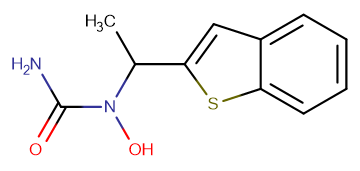
Zileuton
CAS No. 111406-87-2
Zileuton( A 64077 )
Catalog No. M10419 CAS No. 111406-87-2
Zileuton (A-64077) is a selective and potent 5-LO inhibitor, and thus inhibits leukotrienes (LTB4, LTC4, LTD4, and LTE4) formation.
Purity : >98% (HPLC)
 COA
Datasheet
HNMR
HPLC
MSDS
Handing Instructions
COA
Datasheet
HNMR
HPLC
MSDS
Handing Instructions
| Size | Price / USD | Stock | Quantity |
| 1 mL x 10 mM in DMSO | 48 | In Stock |


|
| 10MG | 29 | In Stock |
|
| 25MG | 42 | In Stock |
|
| 50MG | 57 | In Stock |
|
| 100MG | 81 | In Stock |
|
| 200MG | 118 | In Stock |
|
| 500MG | 194 | In Stock |
|
| 1G | Get Quote | In Stock |
|
Biological Information
-
Product NameZileuton
-
NoteResearch use only, not for human use.
-
Brief DescriptionZileuton (A-64077) is a selective and potent 5-LO inhibitor, and thus inhibits leukotrienes (LTB4, LTC4, LTD4, and LTE4) formation.
-
DescriptionZileuton (A-64077) is a selective and potent 5-LO inhibitor, and thus inhibits leukotrienes (LTB4, LTC4, LTD4, and LTE4) formation.(In Vitro):In anti-CD3-treated cells, IL-2 decreases in zileuton-treated and untreated cells with increasing incubation time. Zileuton likely reduces IL-2 levels by inhibiting 5-lipoxygenase, hence leukotriene B4 production, an IL-2 inducer.(In Vivo):In zileuton (5 mg/kg, p.o.) treated I/R rat, the effect of zileuton to decrease NF-κB expression does not change significantly in the presence of COX inhibitors, and the group reveals significantly lower level of NF-κB staining. Zileuton (5 mg/kg, p.o.) treatment given to I/R rats decreases apoptotic index significantly. Zileuton has no significant effect on increased serum TNF-α levels in I/R group. Zileuton (1,200 mg/kg) inhibits the polyp formation in APCΔ468 colon and small intestine. Zileuton treatment inhibits the proliferation rates of non epithelial cells in polyps, and increases the apoptosis rates in polyps in rat. There is significant increase in the number of apoptotic cells in the Zileuton-treated cells both in small intestine and in the colon. The reduced proliferation rate may significantly contribute to the reduction of polyposis in both the small intestine and colon of Zileuton-fed APCΔ468 mice.
-
In VitroIn anti-CD3-treated cells, IL-2 decreases in zileuton-treated and untreated cells with increasing incubation time. Zileuton likely reduces IL-2 levels by inhibiting 5-lipoxygenase, hence leukotriene B4 production, an IL-2 inducer.
-
In VivoIn zileuton (5 mg/kg, p.o.) treated I/R rat, the effect of zileuton to decrease NF-κB expression does not change significantly in the presence of COX inhibitors, and the group reveals significantly lower level of NF-κB staining. Zileuton (5 mg/kg, p.o.) treatment given to I/R rats decreases apoptotic index significantly. Zileuton has no significant effect on increased serum TNF-α levels in I/R group. Zileuton (1,200 mg/kg) inhibits the polyp formation in APCΔ468 colon and small intestine. Zileuton treatment inhibits the proliferation rates of non epithelial cells in polyps, and increases the apoptosis rates in polyps in rat. There is significant increase in the number of apoptotic cells in the Zileuton-treated cells both in small intestine and in the colon. The reduced proliferation rate may significantly contribute to the reduction of polyposis in both the small intestine and colon of Zileuton-fed APCΔ468 mice.
-
SynonymsA 64077
-
PathwayChromatin/Epigenetic
-
TargetCOX
-
RecptorCOX-1| 5-Lipoxygenase
-
Research AreaNeurological Disease
-
Indication——
Chemical Information
-
CAS Number111406-87-2
-
Formula Weight236.29
-
Molecular FormulaC11H12N2O2S
-
Purity>98% (HPLC)
-
SolubilityEthanol: 47 mg/mL (198.9 mM); DMSO: 47 mg/mL (198.9 mM)
-
SMILESO=C(N)N(C(C1=CC2=CC=CC=C2S1)C)O
-
Chemical Name1-(1-(benzo[b]thiophen-2-yl)ethyl)-1-hydroxyurea
Shipping & Storage Information
-
Storage(-20℃)
-
ShippingWith Ice Pack
-
Stability≥ 2 years
Reference
1.Rossi A1, et al. Br J Pharmacol, 2010, 161(3), 555-570.
molnova catalog



related products
-
RO1138452
RO1138452 is a selective and orally bioavailable antagonist of prostacyclin receptor (pKi: 8.3).
-
Agnuside
Agnuside inhibits COX-2 (IC50: 0.026 mg/ml) but exhibits less than 10% inhibition of COX-1 at this concentration. It also inhibits 46.3 66.8 and 82.1% of P-glycoprotein (P-gp) ATPase activity at concentrations of 5 25 and 100 μM respectively.
-
COX-2-IN-2
COX-2-IN-2, a selective inducible COX2 inhibitor, exhibits potent inhibition with an IC50 of 0.24 μM.
