


 Cart
Cart
 sales@molnova.com


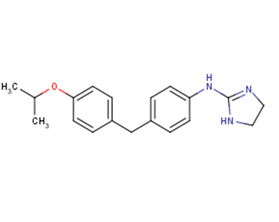
RO1138452
CAS No. 221529-58-4
RO1138452( CAY10441 )
Catalog No. M17442 CAS No. 221529-58-4
RO1138452 is a selective and orally bioavailable antagonist of prostacyclin receptor (pKi: 8.3).
Purity : >98% (HPLC)
 COA
Datasheet
HNMR
HPLC
MSDS
Handing Instructions
COA
Datasheet
HNMR
HPLC
MSDS
Handing Instructions
| Size | Price / USD | Stock | Quantity |
| 1 mL x 10 mM in DMSO | 92 | In Stock |


|
| 2MG | 60 | In Stock |
|
| 5MG | 92 | In Stock |
|
| 10MG | 147 | In Stock |
|
| 25MG | 330 | In Stock |
|
| 50MG | 555 | In Stock |
|
| 100MG | 792 | In Stock |
|
| 200MG | Get Quote | In Stock |
|
| 500MG | Get Quote | In Stock |
|
| 1G | Get Quote | In Stock |
|
Biological Information
-
Product NameRO1138452
-
NoteResearch use only, not for human use.
-
Brief DescriptionRO1138452 is a selective and orally bioavailable antagonist of prostacyclin receptor (pKi: 8.3).
-
DescriptionRO1138452 is a selective and orally bioavailable antagonist of prostacyclin receptor (pKi: 8.3). It antagonizes the carbaprostacyclin-induced activation of human neuroblastoma adenylate cyclase, blocking cyclic AMP accumulation in a dose-dependent manner. Likewise, it inhibits the binding of tritiated iloprost to rodent neuroblastoma cells with a Ki of about 1.5 nM. At levels between 2-20 mg/kg in rats, CAY10441 shows significant analgesic activity in standard antinociceptive assays.
-
In VitroRO1138452 is IP receptor antagonist. The pIC50 values of RO1138452 in attenuating cAMP accumulation is 7.0±0.07. Functional antagonism of RO1138452 is studied by measuring inhibition of carbaprostacyclin-induced cAMP accumulation in CHO-K1 cells stably expressing the human IP receptor. The antagonist affinity (pKi) of RO1138452 is 9.0±0.06. Selectivity profiles for RO1138452 are determined via a panel of receptor binding and enzyme assays. RO1138452 displays affinity at imidazoline2 (I2) (8.3) and platelet activating factor (PAF) (7.9) receptors. RO1138452 (10 pM-10 μM) added to cells concurrently with a fixed concentration of Taprostene (1 μM) prevents, in a concentration-dependent manner, the inhibition of CXCL9 and CXCL10 release, with p[A]50 (molar) values of -8.73±0.11 and -8.47±0.16 (p>0.05), respectively.
-
In VivoRO1138452 is a potent and selective antagonist for both human and rat IP receptors and that is possesses analgesic and anti-inflammatory potential. RO1138452 (1-10?mg/kg, i.v.) significantly reduces acetic acid-induced abdominal constrictions. RO1138452 (3-100?mg/kg, p.o.) significantly reduces carrageenan-induced mechanical hyperalgesia and edema formation. One?hour after administration of RO1138452 (5?mg/kg, i.v.) to rats, the total plasma concentration is 0.189 ?μg/mL, whereas the free plasma concentrations is calculated to be 0.009?μg/mL (28 nM).
-
SynonymsCAY10441
-
PathwayChromatin/Epigenetic
-
TargetCOX
-
Recptorprostacyclin receptor
-
Research AreaInflammation/Immunology
-
Indication——
Chemical Information
-
CAS Number221529-58-4
-
Formula Weight309.41
-
Molecular FormulaC19H23N3O
-
Purity>98% (HPLC)
-
SolubilityDMSO : 33.33 mg/mL. 107.72 mM; H2O : < 0.1 mg/mL
-
SMILESCC(C)Oc1ccc(Cc2ccc(NC3=NCCN3)cc2)cc1
-
Chemical Name——
Shipping & Storage Information
-
Storage(-20℃)
-
ShippingWith Ice Pack
-
Stability≥ 2 years
Reference
1.Clark R D, Jahangir A, Severance D, et al. Bioorganic & medicinal chemistry letters, 2004, 14(4): 1053-1056.
molnova catalog



related products
-
Acetylsalicylic acid
Aspirin (Acetylsalicylic acid) is a potent and selective inhibitor of cyclooxygenase (COX) with a broad range of pharmacological activities including anti-inflammation and pain relief.
-
Tenidap
Tenidap (CP-66248) is a selective COX-1 and SLC26A3 inhibitor with anti-inflammatory, analgesic, and anti-rheumatic activities.
-
RHC 80267
RHC 80267 is a selective inhibitor of DAGL (IC50 : 4 μM in canine platelets).
