


 Cart
Cart
 sales@molnova.com


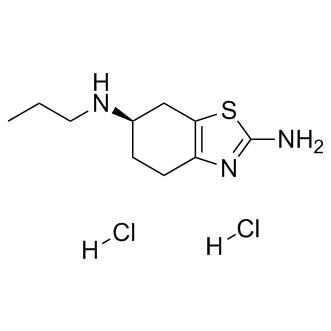
Dexpramipexole dihydrochloride
CAS No. 104632-27-1
Dexpramipexole dihydrochloride( R)-Pramipexole | KNS-760704 )
Catalog No. M10229 CAS No. 104632-27-1
A partial/full agonist of dopamine receptor with Ki of 3.9/2.2/0.5/5.1 nM for D2S/D2L/D3/D4, respeectively.
Purity : >98% (HPLC)
 COA
Datasheet
HNMR
HPLC
MSDS
Handing Instructions
COA
Datasheet
HNMR
HPLC
MSDS
Handing Instructions
| Size | Price / USD | Stock | Quantity |
| 1 mL x 10 mM in DMSO | 46 | In Stock |


|
| 2MG | 29 | In Stock |
|
| 5MG | 42 | In Stock |
|
| 10MG | 68 | In Stock |
|
| 25MG | 140 | In Stock |
|
| 50MG | 212 | In Stock |
|
| 100MG | 303 | In Stock |
|
| 200MG | 452 | In Stock |
|
| 500MG | Get Quote | In Stock |
|
| 1G | Get Quote | In Stock |
|
Biological Information
-
Product NameDexpramipexole dihydrochloride
-
NoteResearch use only, not for human use.
-
Brief DescriptionA partial/full agonist of dopamine receptor with Ki of 3.9/2.2/0.5/5.1 nM for D2S/D2L/D3/D4, respeectively.
-
DescriptionA partial/full agonist of dopamine receptor with Ki of 3.9/2.2/0.5/5.1 nM for D2S/D2L/D3/D4, respeectively; also possesses low/insignificant affinity (500–10,000 nM) for the 5-HT1A, 5-HT1B, 5-HT1D, and α2-adrenergic receptors; used for treating Parkinson's disease (PD) and restless legs syndrome (RLS).Alzheimer's Disease Phase 2 Clinical(In Vitro):Dexpramipexole has been found to have neuroprotective effects and is being investigated for treatment of amyotrophic lateral sclerosis (ALS). Dexpramipexole reduces mitochondrial reactive oxygen species (ROS) production, inhibits the activation of apoptotic pathways, and increase cell survival in response to a variety of neurotoxins and β-amyloid neurotoxicity. Compared to the S-(-) isomer, Dexpramipexole has much lower dopamine agonist activity.
-
In VitroDexpramipexole has been found to have neuroprotective effects and is being investigated for treatment of amyotrophic lateral sclerosis (ALS). Dexpramipexole reduces mitochondrial reactive oxygen species (ROS) production, inhibits the activation of apoptotic pathways, and increase cell survival in response to a variety of neurotoxins and β-amyloid neurotoxicity. Compared to the S-(-) isomer, Dexpramipexole has much lower dopamine agonist activity.
-
In Vivo——
-
SynonymsR)-Pramipexole | KNS-760704
-
PathwayGPCR/G Protein
-
TargetDopamine Receptor
-
RecptorDopamine Receptor
-
Research AreaNeurological Disease
-
IndicationAlzheimer Disease
Chemical Information
-
CAS Number104632-27-1
-
Formula Weight284.249
-
Molecular FormulaC10H19Cl2N3S
-
Purity>98% (HPLC)
-
SolubilityDMSO: ≥ 28 mg/mL
-
SMILESCCCNC1CCC2=C(C1)SC(=N2)N.Cl.Cl
-
Chemical Name2,6-Benzothiazolediamine, 4,5,6,7-tetrahydro-N6-propyl-, hydrochloride (1:2), (6R)-
Shipping & Storage Information
-
Storage(-20℃)
-
ShippingWith Ice Pack
-
Stability≥ 2 years
Reference
1. Alavian KN, et al. Brain Res. 2012 Mar 29;1446:1-11.
2. Cudkowicz M, et al. Nat Med. 2011 Nov 20;17(12):1652-6.
3. Bozik ME, et al. J Clin Pharmacol. 2011 Aug;51(8):1177-85.
molnova catalog



related products
-
Aplindore Fumarate
Aplindore Fumarate (DAB-452) is a small molecule dopamine D2 receptor partial agonist.Aplindore Fumarate exhibits high affinity for dopamine D2 and D3 receptors, and low affinity for dopamine D4, 5-hydroxytryptophan (5-HT2), and α1-adrenergic receptors.
-
Prochlorperazine Mal...
A phenothiazine antipsychotic used principally in the treatment of nausea; vomiting; and vertigo.
-
Fananserin
Fananserin is an effective, selective and oral active antagonist of 5-HT2 (Ki = 0.37 nM for the rat 5-HT2A).
