


 Cart
Cart
 sales@molnova.com


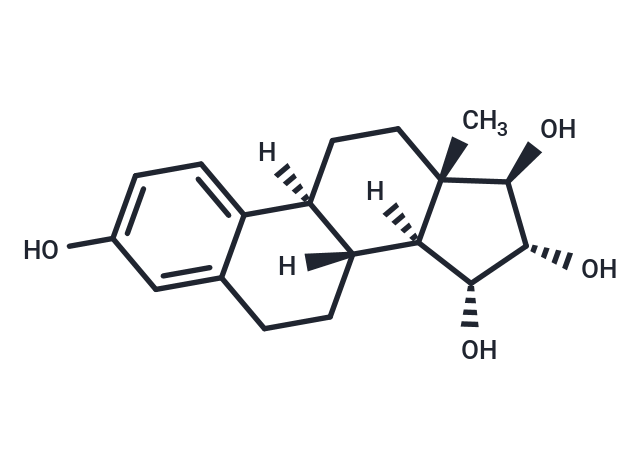
Estetrol
CAS No. 15183-37-6
Estetrol( —— )
Catalog No. M33354 CAS No. 15183-37-6
Estetrol(Donesta) is an orally available, selective modulator of the estrogen receptor, a naturally occurring estrogen synthesized by the human fetal liver during pregnancy.
Purity : >98% (HPLC)
 COA
Datasheet
HNMR
HPLC
MSDS
Handing Instructions
COA
Datasheet
HNMR
HPLC
MSDS
Handing Instructions
| Size | Price / USD | Stock | Quantity |
| 2MG | 195 | Get Quote |


|
| 5MG | 310 | Get Quote |
|
| 10MG | 462 | Get Quote |
|
| 25MG | 716 | Get Quote |
|
| 50MG | 975 | Get Quote |
|
| 100MG | 1287 | Get Quote |
|
| 500MG | Get Quote | Get Quote |
|
| 1G | Get Quote | Get Quote |
|
Biological Information
-
Product NameEstetrol
-
NoteResearch use only, not for human use.
-
Brief DescriptionEstetrol(Donesta) is an orally available, selective modulator of the estrogen receptor, a naturally occurring estrogen synthesized by the human fetal liver during pregnancy.
-
DescriptionEstetrol, a natural estrogen synthesized exclusively during pregnancy by the human fetal liver, is a selective nuclear estrogen receptor modulator. Estetrol exerts estrogenic actions on the endometrium or the central nervous system but presents antagonistic effects on the breast.
-
In Vitro——
-
In Vivo——
-
Synonyms——
-
PathwayProteasome/Ubiquitin
-
TargetEndogenous Metabolite
-
RecptorEndogenous Metabolite | Estrogen Receptor/ERR
-
Research Area——
-
Indication——
Chemical Information
-
CAS Number15183-37-6
-
Formula Weight304.38
-
Molecular FormulaC18H24O4
-
Purity>98% (HPLC)
-
SolubilityIn Vitro:?DMSO : 100 mg/mL (328.54 mM; Ultrasonic )
-
SMILESC[C@@]12[C@]([C@]3([C@@](C=4C(CC3)=CC(O)=CC4)(CC1)[H])[H])([C@@H](O)[C@@H](O)[C@@H]2O)[H]
-
Chemical Name——
Shipping & Storage Information
-
Storage(-20℃)
-
ShippingWith Ice Pack
-
Stability≥ 2 years
Reference
1. Valéra MC, et al. Effect of estetrol, a selective nuclear estrogen receptor modulator, in mouse models of arterial and venous thrombosis. Mol Cell Endocrinol. 2018 Dec 5;477:132-139.?
molnova catalog



related products
-
Leucyl-phenylalanine
Leucyl-phenylalanine (H-LEU-PHE-OH) is a dipeptide compound that can be used for protein synthesis.
-
L(+)-Asparagine mono...
L(+)-Asparagine monohydrate is a non-essential amino acid participate in neurological and metabolic regulation of tissue cell function.
-
(L)-Dehydroascorbic ...
L-Dehydro Ascorbic Acid is the reversibly oxidized form of ascorbic acid;Dehydroascorbic acid a blood-brain barrier transportable form of vitamin C mediates potent cerebroprotection in experimental stroke.
