


 Cart
Cart
 sales@molnova.com


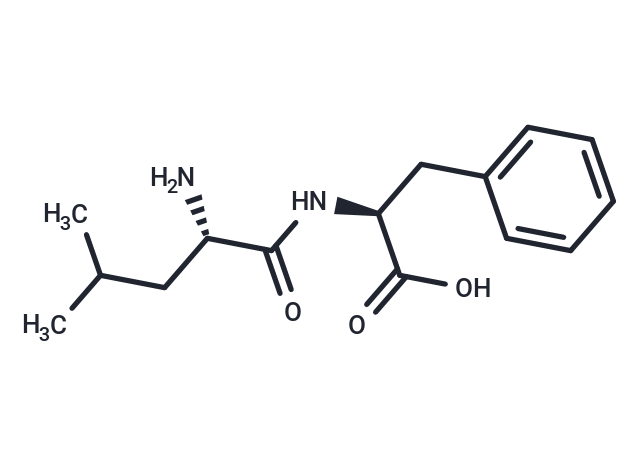
Leucyl-phenylalanine
CAS No. 3063-05-6
Leucyl-phenylalanine( —— )
Catalog No. M33609 CAS No. 3063-05-6
Leucyl-phenylalanine (H-LEU-PHE-OH) is a dipeptide compound that can be used for protein synthesis.
Purity : >98% (HPLC)
 COA
Datasheet
HNMR
HPLC
MSDS
Handing Instructions
COA
Datasheet
HNMR
HPLC
MSDS
Handing Instructions
| Size | Price / USD | Stock | Quantity |
| 10MG | 28 | In Stock |


|
| 100MG | Get Quote | In Stock |
|
| 200MG | Get Quote | In Stock |
|
| 500MG | Get Quote | In Stock |
|
| 1G | Get Quote | In Stock |
|
Biological Information
-
Product NameLeucyl-phenylalanine
-
NoteResearch use only, not for human use.
-
Brief DescriptionLeucyl-phenylalanine (H-LEU-PHE-OH) is a dipeptide compound that can be used for protein synthesis.
-
DescriptionLeucyl-phenylalanine belongs to the class of organic compounds known as dipeptides.
-
In Vitro——
-
In Vivo——
-
Synonyms——
-
PathwayProteasome/Ubiquitin
-
TargetEndogenous Metabolite
-
RecptorEndogenous Metabolite
-
Research Area——
-
Indication——
Chemical Information
-
CAS Number3063-05-6
-
Formula Weight278.35
-
Molecular FormulaC15H22N2O3
-
Purity>98% (HPLC)
-
SolubilityIn Vitro:?H2O : 4 mg/mL (14.37 mM; Ultrasonic)Ethanol : 1.11 mg/mL (3.99 mM; Ultrasonic)DMSO : < 1 mg/mL (insoluble or slightly soluble)
-
SMILESC([C@H](NC([C@H](CC(C)C)N)=O)C(O)=O)C1=CC=CC=C1
-
Chemical Name——
Shipping & Storage Information
-
Storage(-20℃)
-
ShippingWith Ice Pack
-
Stability≥ 2 years
Reference
molnova catalog



related products
-
(S)-3-Hydroxybutanoi...
(S)-3-Hydroxybutyric acid is a normal human metabolite that has been found elevated in geriatric patients remitting from depression.
-
2-hydroxymethyl benz...
2-hydroxymethyl benzoic acid is a principal metabolite of the phthalidyl moiety in man.
-
L-23-Diaminopropioni...
L-23-diaminopropionic acid is an amino acid that is a precursor of antibiotics and staphyloferrin B a siderophore produced by Staphylococcus aureus.
