


 Cart
Cart
 sales@molnova.com


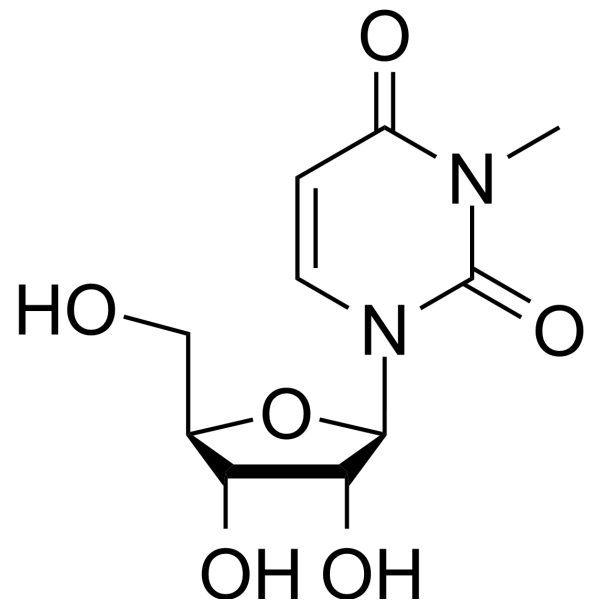
3-Methyluridine
CAS No. 2140-69-4
3-Methyluridine( Nsc 246077 | N3-Methyluridine )
Catalog No. M26538 CAS No. 2140-69-4
3-Methyluridine is a modified RNA nucleoside of cellular RNA and commonly found in the form of RNA modifications.
Purity : >98% (HPLC)
 COA
Datasheet
HNMR
HPLC
MSDS
Handing Instructions
COA
Datasheet
HNMR
HPLC
MSDS
Handing Instructions
| Size | Price / USD | Stock | Quantity |
| 5MG | 72 | In Stock |


|
| 10MG | 115 | In Stock |
|
| 25MG | 237 | In Stock |
|
| 50MG | 354 | In Stock |
|
| 100MG | 527 | In Stock |
|
| 200MG | Get Quote | In Stock |
|
| 500MG | Get Quote | In Stock |
|
| 1G | Get Quote | In Stock |
|
Biological Information
-
Product Name3-Methyluridine
-
NoteResearch use only, not for human use.
-
Brief Description3-Methyluridine is a modified RNA nucleoside of cellular RNA and commonly found in the form of RNA modifications.
-
Description3-Methyluridine is a modified RNA nucleoside of cellular RNA and commonly found in the form of RNA modifications.
-
In Vitro——
-
In Vivo——
-
SynonymsNsc 246077 | N3-Methyluridine
-
PathwayProteasome/Ubiquitin
-
TargetEndogenous Metabolite
-
RecptorIGF-1R| Insulin Receptor 1| Insulin Receptor 2| STAT3
-
Research Area——
-
Indication——
Chemical Information
-
CAS Number2140-69-4
-
Formula Weight258.23
-
Molecular FormulaC10H14N2O6
-
Purity>98% (HPLC)
-
SolubilityIn Vitro:?DMSO : 160 mg/mL (619.60 mM)
-
SMILESCn1c(=O)ccn([C@@H]2O[C@H](CO)[C@@H](O)[C@H]2O)c1=O
-
Chemical Name——
Shipping & Storage Information
-
Storage(-20℃)
-
ShippingWith Ice Pack
-
Stability≥ 2 years
Reference
1.Reuveni H, Flashner-Abramson E, Steiner L, Makedonski K, Song R, Shir A, Herlyn M, Bar-Eli M, Levitzki A. Therapeutic destruction of insulin receptor substrates for cancer treatment. Cancer Res. 2013 Jul 15;73(14):4383-94.
molnova catalog



related products
-
Taurodeoxycholate so...
Taurodeoxycholate sodium salt is a bile salt-related anionic detergent used for isolation of membrane proteins including inner mitochondrial membrane proteins. and it inhibits various inflammatory responses
-
N-Acetylputrescine h...
N-Acetylputrescine is a polyamine commonly occurring excreted in normal human urine.
-
N-Acetylhistamine
N-Acetylhistamine is a metabolite of histamine.
