


 Cart
Cart
 sales@molnova.com


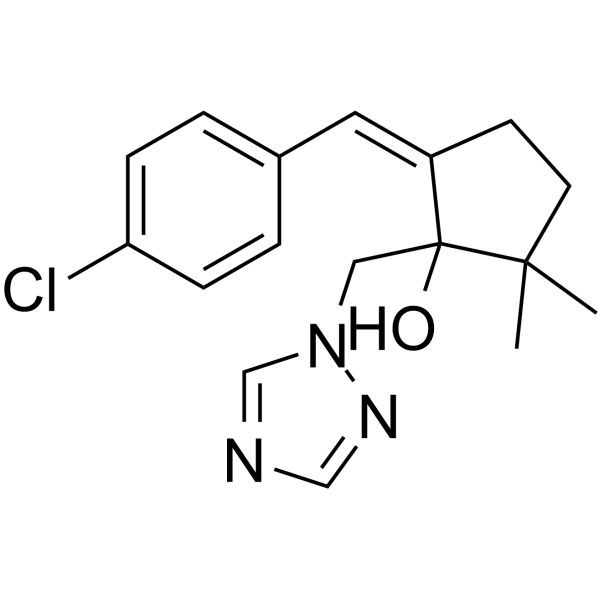
Triticonazole
CAS No. 131983-72-7
Triticonazole( —— )
Catalog No. M28346 CAS No. 131983-72-7
Triticonazole is a triazole pesticide. Triticonazole is an azole fungicide and shows endocrine disrupting activities.
Purity : >98% (HPLC)
 COA
Datasheet
HNMR
HPLC
MSDS
Handing Instructions
COA
Datasheet
HNMR
HPLC
MSDS
Handing Instructions
| Size | Price / USD | Stock | Quantity |
| 5MG | 45 | Get Quote |


|
| 10MG | 68 | Get Quote |
|
| 25MG | 115 | Get Quote |
|
| 50MG | 173 | Get Quote |
|
| 100MG | 258 | Get Quote |
|
| 200MG | 388 | Get Quote |
|
| 500MG | 642 | Get Quote |
|
| 1G | Get Quote | Get Quote |
|
Biological Information
-
Product NameTriticonazole
-
NoteResearch use only, not for human use.
-
Brief DescriptionTriticonazole is a triazole pesticide. Triticonazole is an azole fungicide and shows endocrine disrupting activities.
-
DescriptionTriticonazole is a triazole pesticide. Triticonazole is an azole fungicide and shows endocrine disrupting activities.
-
In Vitro——
-
In Vivo——
-
Synonyms——
-
PathwayGPCR/G Protein
-
TargetAntibacterial
-
Recptor——
-
Research Area——
-
Indication——
Chemical Information
-
CAS Number131983-72-7
-
Formula Weight317.82
-
Molecular FormulaC17H20ClN3O
-
Purity>98% (HPLC)
-
Solubility——
-
SMILESCC1(C)CCC(=Cc2ccc(Cl)cc2)C1(O)Cn1cncn1
-
Chemical Name——
Shipping & Storage Information
-
Storage(-20℃)
-
ShippingWith Ice Pack
-
Stability≥ 2 years
Reference
1.Wang ZC, Feng DQ, Ke CH. Coumarins from the Herb Cnidium monnieri and chemically modified derivatives as antifoulants against Balanus albicostatus and Bugula neritina larvae. Int J Mol Sci. 2013 Jan 9;14(1):1197-206.
molnova catalog



related products
-
Cefotiam hydrochlori...
Cefotiam hydrochloride is a second-generation cephalosporin antibiotic, has broad-spectrum activity against Gram-positive and Gram-negative bacteria.
-
ML406
ML406 is a small molecule Mtb bioA (DAPA synthase) enzyme inhibitor (IC50=30 nM) that shows anti-tubercular activity.
-
Chebulinic acid
Chebulinic acid is a potent inhibitor of M. tuberculosis DNA gyrase. It also can inhibit SMAD-3 phosphorylation and H+ K+-ATPase activity.Chebulinic acid obviously inhibited HQ/Cu(II)- and H(2)O(2)/Cu(II)-mediated pBR322 DNA strand breaks. When MRC-5 cells were treated with HQ/Cu(II), the presence of Chebulinic acid inhibited HQ/Cu(II)-mediated double-strand breaks of genomic DNA.
