


 Cart
Cart
 sales@molnova.com


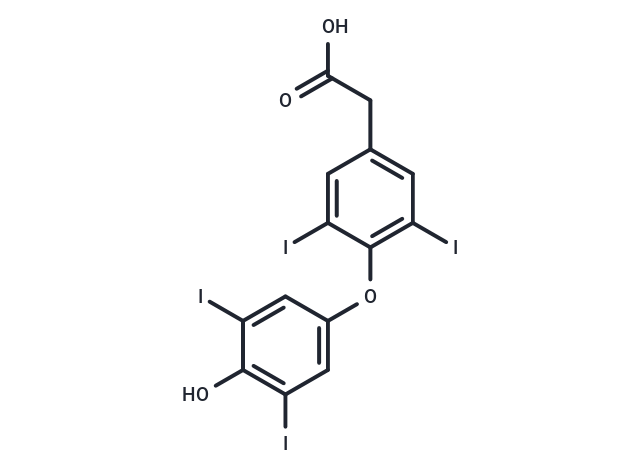
Tetrac
CAS No. 67-30-1
Tetrac( —— )
Catalog No. M34879 CAS No. 67-30-1
Tetrac (Tetraiodothyroacetic acid) is a derivative of L-thyroxine (T4), a thyroxine integrin receptor antagonist.Tetrac induces antiproliferation by blocking EGFR-mediated cell signaling in colorectal cancer cells.
Purity : >98% (HPLC)
 COA
Datasheet
HNMR
HPLC
MSDS
Handing Instructions
COA
Datasheet
HNMR
HPLC
MSDS
Handing Instructions
| Size | Price / USD | Stock | Quantity |
| 10MG | 37 | In Stock |


|
| 25MG | 73 | In Stock |
|
| 50MG | 109 | In Stock |
|
| 100MG | 156 | In Stock |
|
| 500MG | 394 | In Stock |
|
| 1G | Get Quote | In Stock |
|
Biological Information
-
Product NameTetrac
-
NoteResearch use only, not for human use.
-
Brief DescriptionTetrac (Tetraiodothyroacetic acid) is a derivative of L-thyroxine (T4), a thyroxine integrin receptor antagonist.Tetrac induces antiproliferation by blocking EGFR-mediated cell signaling in colorectal cancer cells.
-
DescriptionTetrac (Tetraiodothyroacetic acid), a derivative of L-thyroxine (T4), is a thyrointegrin receptor antagonist. Tetrac blocks the actions of T4 and 3,5,3'-triiodo-L-thyronine (T3) at the cell surface receptor for thyroid hormone on integrin αvβ3. Tetra has anti-angiogenic and anti-tumor activities.
-
In VitroTetrac (0.01-1 μM; 2-6 d) induces anti-proliferation in HT-29 and HCT116 cells with different K-RAS status.Tetrac (0.1 μM; 30 min) inhibits activation of ERK1/2 in HT-29 and HCT116 cells.Tetrac (0.1 μM; 24 h) inhibits expression of CCND1 and c-Myc, but promotes expression of CASP2 and THBS1.Cell Proliferation Assay Cell Line:HT-29 and HCT116 cells Concentration:0.01, 0.1, 1 μM Incubation Time:0, 2, 4, 6 days Result:Induced anti-proliferation of K-RAS wild-type colorectal cancer cells.Western Blot Analysis Cell Line:HT-29 and HCT116 cells Concentration:0.1 μM Incubation Time:30 min Result:Inhibited constitutively activated ERK1/2, and this inhibition can remove by anti-integrin αvβ3 antibody pretreatment.
-
In VivoTetrac (35 μg; p.o. for 40 days) inhibits tumor inoculation, growth and integrin expression in mice.Animal Model:Wild-type male Balb/C mice aged 8 weeks are inoculated with 102B16F10 or B16LS9 cells Dosage:35 μg per day Administration:P.o. (added to the drinking water) daily for 40 days Result:Delayed the onset of ocular melanoma.Reduced the S-100 and integrin staining level in the B16F10 mice model.
-
Synonyms——
-
PathwayApoptosis
-
TargetApoptosis
-
RecptorApoptosis | EGFR
-
Research Area——
-
Indication——
Chemical Information
-
CAS Number67-30-1
-
Formula Weight747.83
-
Molecular FormulaC14H8I4O4
-
Purity>98% (HPLC)
-
SolubilityIn Vitro:?DMSO : 100 mg/mL (133.72 mM; Ultrasonic )
-
SMILESOC(=O)Cc1cc(I)c(Oc2cc(I)c(O)c(I)c2)c(I)c1
-
Chemical Name——
Shipping & Storage Information
-
Storage(-20℃)
-
ShippingWith Ice Pack
-
Stability≥ 2 years
Reference
1. Schmohl KA, et, al. Tetrac as an anti-angiogenic agent in cancer. Endocr Relat Cancer. 2019 Jun 1; 26(6):R287-R304.?
molnova catalog



related products
-
Tubulin inhibitor 32
Tubulin inhibitor 32 is an orally active novel microtubule inhibitor with antiproliferative and antitumor activity, inhibits microtubule polymerization, induces apoptosis and cell cycle arrest in G2/M phase.
-
icFSP1
icFSP1 is a mitochondria-associated apoptosis-inducing factor regulator with antitumor activity for the study and treatment of tumor diseases.
-
Anticancer agent 110
Anticancer Agent 110 exhibits potent in vitro anti-leukemia activity, demonstrating high cytotoxicity against K-562 lineage chronic myelogenous leukemia cells at nanomolar concentrations.
