


 Cart
Cart
 sales@molnova.com


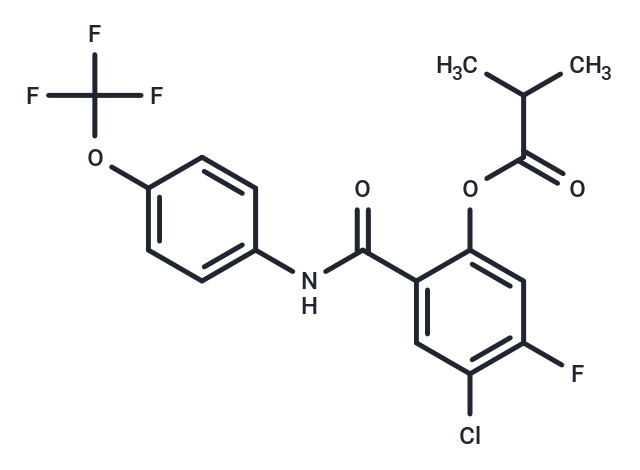
SARS-CoV-2-IN-38
CAS No. 2882823-27-8
SARS-CoV-2-IN-38( —— )
Catalog No. M37222 CAS No. 2882823-27-8
SARS-CoV-2-IN-38 is an orally available SARS-CoV-2 inhibitor with potential antiviral activity for the study of SARS viral infections.
Purity : >98% (HPLC)
 COA
Datasheet
HNMR
HPLC
MSDS
Handing Instructions
COA
Datasheet
HNMR
HPLC
MSDS
Handing Instructions
| Size | Price / USD | Stock | Quantity |
| 2MG | 445 | Get Quote |


|
| 5MG | 686 | Get Quote |
|
| 10MG | 938 | Get Quote |
|
| 25MG | 1398 | Get Quote |
|
| 50MG | 1822 | Get Quote |
|
| 500MG | Get Quote | Get Quote |
|
| 1G | Get Quote | Get Quote |
|
Biological Information
-
Product NameSARS-CoV-2-IN-38
-
NoteResearch use only, not for human use.
-
Brief DescriptionSARS-CoV-2-IN-38 is an orally available SARS-CoV-2 inhibitor with potential antiviral activity for the study of SARS viral infections.
-
DescriptionSARS-CoV-2-IN-38 (compound 24) is a SARS-CoV-2 inhibitor with good oral bioavailability in mice (F%=39.75%).
-
In Vitro——
-
In Vivo——
-
Synonyms——
-
PathwayOthers
-
TargetOther Targets
-
RecptorSARS-CoV
-
Research Area——
-
Indication——
Chemical Information
-
CAS Number2882823-27-8
-
Formula Weight419.76
-
Molecular FormulaC18H14ClF4NO4
-
Purity>98% (HPLC)
-
Solubility——
-
SMILESO=C(OC1=CC(F)=C(Cl)C=C1C(=O)NC2=CC=C(OC(F)(F)F)C=C2)C(C)C
-
Chemical Name——
Shipping & Storage Information
-
Storage(-20℃)
-
ShippingWith Ice Pack
-
Stability≥ 2 years
Reference
1. Li R, et al. Synthesis, cytotoxicity, and pharmacokinetic evaluations of niclosamide analogs for anti-SARS-CoV-2. Eur J Med Chem. 2023 May 5;253:115320. ?
molnova catalog



related products
-
N-Nonyldeoxynojirimy...
N-Nonyldeoxynojirimycin (NN-DNJ) is an inhibitor of acid α-glucosidase and α-1,6-glucosidase (IC50s = 0.42 and 8.4 μM, respectively).
-
5-Methoxy-DL-tryptop...
5-Methoxy-DL-tryptophan is a molecule produced by endothelial cells to modulate inflammatory responses and protect against systemic inflammation.
-
Astragaloside
Astragaloside may protect against brain contusion and neuronal apoptosis after TBI by attenuating microglia activation in male rats.
