


 Cart
Cart
 sales@molnova.com


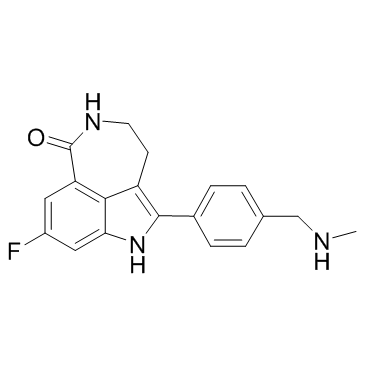
Rucaparib
CAS No. 283173-50-2
Rucaparib( AG014699 | PF01367338 | AG 014699 | PF 01367338 )
Catalog No. M13861 CAS No. 283173-50-2
An inhibitor of PARP with Ki of 1.4 nM for PARP1 in a cell-free assay, also showing binding affinity to eight other PARP domains.
Purity : >98% (HPLC)
 COA
Datasheet
HNMR
HPLC
MSDS
Handing Instructions
COA
Datasheet
HNMR
HPLC
MSDS
Handing Instructions
| Size | Price / USD | Stock | Quantity |
| 2MG | 37 | In Stock |


|
| 5MG | 60 | In Stock |
|
| 10MG | 105 | In Stock |
|
| 25MG | 165 | In Stock |
|
| 50MG | 222 | In Stock |
|
| 100MG | 345 | In Stock |
|
| 200MG | 511 | In Stock |
|
| 500MG | 824 | In Stock |
|
| 1G | Get Quote | In Stock |
|
Biological Information
-
Product NameRucaparib
-
NoteResearch use only, not for human use.
-
Brief DescriptionAn inhibitor of PARP with Ki of 1.4 nM for PARP1 in a cell-free assay, also showing binding affinity to eight other PARP domains.
-
DescriptionAn inhibitor of PARP with Ki of 1.4 nM for PARP1 in a cell-free assay, also showing binding affinity to eight other PARP domains; inhibits PARP-1 activity by 97.1% at a concentration of 1 μM in permeabilised D283Med cells; enhances the antitumor activity of temozolomide and indicates complete and sustained tumor regression in NB1691 and SHSY5Y xenografts.Ovarian Cancer Approved(In Vitro):Rucaparib (AG014699) is a possible N-demethylation metabolite of AG14644.Rucaparib (0.1, 1, 10, 100 μM; 24 hours) is cytotoxic and has the LC50 being 5?μM in Capan-1 (BRCA2 mutant) cells and only 100?nM in MX-1 (BRCA1 mutant) cells.The radio-sensitization by Rucaparib is due to downstream inhibition of activation of NF-κB, and is independent of SSB repair inhibition. Rucaparib can target NF-κB activated by DNA damage and overcome toxicity observed with classical NF-κB inhibitors without compromising other vital inflammatory functions.Rucaparib inhibits PARP-1 activity by 97.1% at a concentration of 1 μM in permeabilised D283Med cells.(In Vivo):Rucaparib (AG014699) and AG14584 significantly increase Temozolomide toxicity. Rucaparib (1 mg/kg) significantly increases Temozolomide-induced body weight loss. Rucaparib (0.1 mg/kg) results in a 50% increase in the temozolomide-induced tumor growth delay.Rucaparib (10?mg/kg for i.p. or 50, 150 mg/kg for p.o.; daily for 5 days per week for 6 weeks) significantly inhibits the growth of the tumor, and there is one complete tumor regression and two persistent partial regressions.Rucaparib (150?mg/kg; p.o.; once per week for 6 weeks or three times per week for 6 weeks) has greatest antitumor effect with three complete regressions.Rucaparib enhances the antitumor activity of temozolomide and indicates complete and sustained tumor regression in NB1691 and SHSY5Y xenografts.
-
In VitroRucaparib (AG014699) is a possible N-demethylation metabolite of AG14644. Rucaparib (0.1, 1, 10, 100 μM; 24 hours) is cytotoxic and has the LC50 being 5?μM in Capan-1 (BRCA2 mutant) cells and only 100?nM in MX-1 (BRCA1 mutant) cells. The radio-sensitization by Rucaparib is due to downstream inhibition of activation of NF-κB, and is independent of SSB repair inhibition. Rucaparib can target NF-κB activated by DNA damage and overcome toxicity observed with classical NF-κB inhibitors without compromising other vital inflammatory functions. Rucaparib inhibits PARP-1 activity by 97.1% at a concentration of 1 μM in permeabilised D283Med cells.
-
In VivoRucaparib (AG014699) and AG14584 significantly increase Temozolomide toxicity. Rucaparib (1 mg/kg) significantly increases Temozolomide-induced body weight loss. Rucaparib (0.1 mg/kg) results in a 50% increase in the temozolomide-induced tumor growth delay. Rucaparib (10?mg/kg for i.p. or 50, 150 mg/kg for p.o.; daily for 5 days per week for 6 weeks) significantly inhibits the growth of the tumor, and there is one complete tumor regression and two persistent partial regressions.Rucaparib (150?mg/kg; p.o.; once per week for 6 weeks or three times per week for 6 weeks) has greatest antitumor effect with three complete regressions. Rucaparib enhances the antitumor activity of temozolomide and indicates complete and sustained tumor regression in NB1691 and SHSY5Y xenografts. Animal Model:Female CD-1 nude mice aged 10-12 weeks with Capan-1 cells Dosage:10?mg/kg for i.p. or 50, 150 mg/kg for p.o.Administration:IP or PO Result:Significantly inhibited the growth of the tumor.
-
SynonymsAG014699 | PF01367338 | AG 014699 | PF 01367338
-
PathwayCell Cycle/DNA Damage
-
TargetPARP
-
RecptorPARP1
-
Research AreaCancer
-
IndicationOvarian Cancer
Chemical Information
-
CAS Number283173-50-2
-
Formula Weight323.3641
-
Molecular FormulaC19H18FN3O
-
Purity>98% (HPLC)
-
Solubility10 mM in DMSO
-
SMILESCNCC1=CC=C(C=C1)C2=C3CCNC(=O)C4=C3C(=CC(=C4)F)N2
-
Chemical Name6H-Pyrrolo[4,3,2-ef][2]benzazepin-6-one, 8-fluoro-1,3,4,5-tetrahydro-2-[4-[(methylamino)methyl]phenyl]-
Shipping & Storage Information
-
Storage(-20℃)
-
ShippingWith Ice Pack
-
Stability≥ 2 years
Reference
1. Thomas HD, et al. Mol Cancer Ther, 2007, 6(3), 945-956.
2. Daniel RA, et al. Clin Cancer Res, 2009, 15(4), 1241-1249.
3. Daniel RA, et al. Br J Cancer, 2010, 103(10), 1588-1596.
molnova catalog



related products
-
PARP10-IN-3
PARP10-IN-3 is a potent and selective mono-Adp-ribotransferase PARP10 inhibitor that inhibits human PARP10 (IC50:480 nM). PARP10-IN-3 also inhibited human PARP2 and human PARP15 with IC50 values of 1.7 μM.
-
Pamiparib
Pamiparib (BGB-290, BGB290) is a?highly potent, selective and brain penetrant PARP1/2 inhibitor with potent anti-tumor activity.
-
PARP-1-IN-3
PARP-1-IN-3 is a potent PARP-1 inhibitor that inhibits PARP-1 and PARP-2 with IC50 values of 0.25 nM and 2.34 nM, respectively.
