


 Cart
Cart
 sales@molnova.com


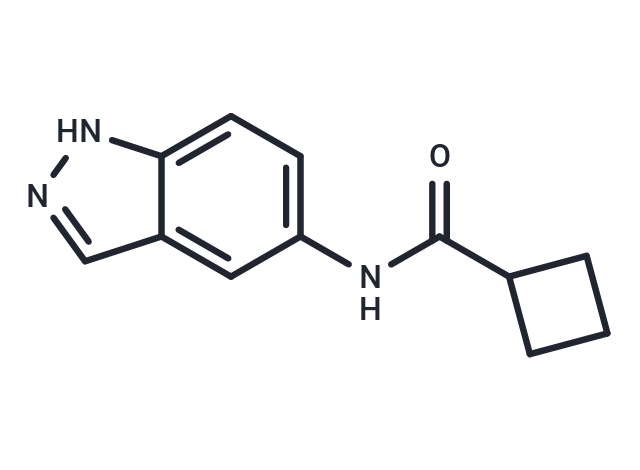
Rhodblock 6
CAS No. 886625-06-5
Rhodblock 6( —— )
Catalog No. M34126 CAS No. 886625-06-5
Rhodblock 6 is a Rho kinase (ROCK) inhibitor that specifically inhibits Rho kinase activity and the localization of phosphorylated MRLC (Myosin Regulatory Light Chain).
Purity : >98% (HPLC)
 COA
Datasheet
HNMR
HPLC
MSDS
Handing Instructions
COA
Datasheet
HNMR
HPLC
MSDS
Handing Instructions
| Size | Price / USD | Stock | Quantity |
| 2MG | 68 | Get Quote |


|
| 5MG | 101 | Get Quote |
|
| 10MG | 163 | Get Quote |
|
| 25MG | 334 | Get Quote |
|
| 50MG | 495 | Get Quote |
|
| 100MG | 689 | Get Quote |
|
| 500MG | Get Quote | Get Quote |
|
| 1G | Get Quote | Get Quote |
|
Biological Information
-
Product NameRhodblock 6
-
NoteResearch use only, not for human use.
-
Brief DescriptionRhodblock 6 is a Rho kinase (ROCK) inhibitor that specifically inhibits Rho kinase activity and the localization of phosphorylated MRLC (Myosin Regulatory Light Chain).
-
DescriptionRhodblock 6 is a Rho kinase (ROCK) inhibitor that inhibits phospho-MRLC (myosin regulatory light chain) localization.
-
In Vitro——
-
In Vivo——
-
Synonyms——
-
PathwayCell Cycle/DNA Damage
-
TargetROCK
-
RecptorROCK
-
Research Area——
-
Indication——
Chemical Information
-
CAS Number886625-06-5
-
Formula Weight215.25
-
Molecular FormulaC12H13N3O
-
Purity>98% (HPLC)
-
Solubility——
-
SMILESN(C(=O)C1CCC1)C=2C=C3C(=CC2)NN=C3
-
Chemical Name——
Shipping & Storage Information
-
Storage(-20℃)
-
ShippingWith Ice Pack
-
Stability≥ 2 years
Reference
1. Adam B Castoreno, et al. Small molecules discovered in a pathway screen target the Rho pathway in cytokinesis. Nat Chem Biol. 2010 Jun;6(6):457-63. ?
molnova catalog



related products
-
(1R,2S)-VU0155041
(1R,2S)-VU0155041 is a partial agonist of mGluR4(EC50 of 2.35 μM).
-
Ripasudil free base
Ripasudil free base is a selective and potent ROCK inhibitor is a novel and potent antiglaucoma agent.
-
AS 1892802
AS 1892802 is a potent and selective inhibitor of ROCK. AS 1892802 exibits IC50 values of 52nM, 57nM and 122 nM for human ROCK2, rat ROCK2 and human ROCK1, respectively.
