


 Cart
Cart
 sales@molnova.com


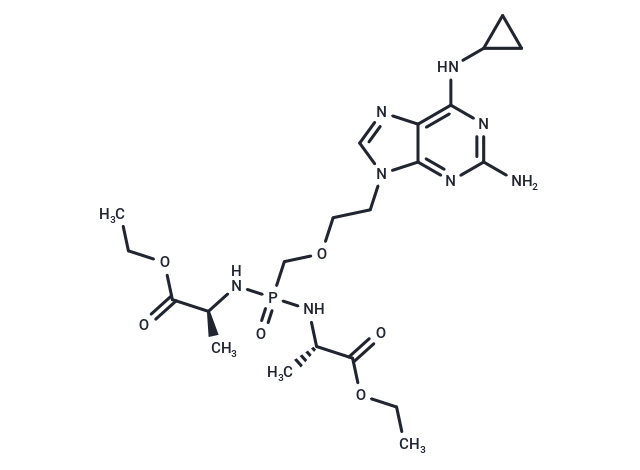
Rabacfosadine
CAS No. 859209-74-8
Rabacfosadine( —— )
Catalog No. M33476 CAS No. 859209-74-8
Rabacfosadine (GS-9219) is a novel dual pre-drug of the acyclic nucleotide phosphonate PMEG to tumor lymphocytes for the study of lymphoma.
Purity : >98% (HPLC)
 COA
Datasheet
HNMR
HPLC
MSDS
Handing Instructions
COA
Datasheet
HNMR
HPLC
MSDS
Handing Instructions
| Size | Price / USD | Stock | Quantity |
| 2MG | 240 | Get Quote |


|
| 5MG | 370 | Get Quote |
|
| 10MG | 550 | Get Quote |
|
| 25MG | 854 | Get Quote |
|
| 50MG | 1159 | Get Quote |
|
| 100MG | 1512 | Get Quote |
|
| 500MG | Get Quote | Get Quote |
|
| 1G | Get Quote | Get Quote |
|
Biological Information
-
Product NameRabacfosadine
-
NoteResearch use only, not for human use.
-
Brief DescriptionRabacfosadine (GS-9219) is a novel dual pre-drug of the acyclic nucleotide phosphonate PMEG to tumor lymphocytes for the study of lymphoma.
-
DescriptionRabacfosadine (GS-9219), a novel proagent of the nucleotide analogue PMEG, is designed as a cytotoxic agent that preferentially targets lymphoid cells.
-
In VitroIn lymphocytes, Rabacfosadine (GS-9219) is converted to its active metabolite, 9-(2-phosphonylmethoxyethyl)guanine (PMEG) diphosphate, via enzymatic hydrolysis, deamination, and phosphorylation. GS-9219 has substantial antiproliferative activity against activated lymphocytes and hematopoietic tumor cell lines. The ability of Rabacfosadine to inhibit the proliferation of activated lymphocytes and of tumor cells of hematopoietic origin is investigated. Rabacfosadine inhibits the proliferation of mitogen-stimulated T and B lymphocytes with EC50 values of 135 and 42 nM, respectively, as determined by BrdUrd incorporation. To compare the activity of GS-9219 in dividing and nondividing cells, Rabacfosadine is evaluated in these populations using a metabolism-based sodium XTT assay instead of BrdUrd assays. Results from the XTT assay shows a 127-fold difference between the EC50 values of Rabacfosadine in quiescent (EC50=17.2 μM) and proliferating (EC50=135 nM) cells. These results indicate a substantial selectivity of Rabacfosadine toward actively replicating lymphoblasts.
-
In VivoRabacfosadine (RAB) has substantial single-agent activity in dogs with lymphoma, and a different mechanism of action than Doxorubicin (DOX). Open-label, multicenter prospective clinical trial. Dogs receive alternating Rabacfosadine (1.0 mg/kg IV weeks 0, 6, 12) and Doxorubicin (30 mg/m2 IV weeks 3, 9, 15). Dogs that achieved complete response (CR) are followed by monthly evaluations. Complete clinicopathological evaluation and assessment of remission and adverse event (AEs) are performed every 21 days. Acute AEs, occurring within 21 days after administration of the first dose of each agent, are compared between Rabacfosadine and Doxorubicin in 46 dogs receiving at least 1 dose of each agent.
-
Synonyms——
-
PathwayMicrobiology/Virology
-
TargetAntibiotic
-
RecptorNucleoside Antimetabolite/Analog
-
Research Area——
-
Indication——
Chemical Information
-
CAS Number859209-74-8
-
Formula Weight526.53
-
Molecular FormulaC21H35N8O6P
-
Purity>98% (HPLC)
-
SolubilityIn Vitro:?DMSO : 100 mg/mL (189.92 mM; Ultrasonic )
-
SMILESC(COCP(N[C@H](C(OCC)=O)C)(N[C@H](C(OCC)=O)C)=O)N1C=2C(=C(NC3CC3)N=C(N)N2)N=C1
-
Chemical Name——
Shipping & Storage Information
-
Storage(-20℃)
-
ShippingWith Ice Pack
-
Stability≥ 2 years
Reference
1. Reiser H, et al. GS-9219--a novel acyclic nucleotide analogue with potent antineoplastic activity in dogs with spontaneous non-Hodgkin's lymphoma. Clin Cancer Res. 2008 May 1;14(9):2824-32.?
molnova catalog



related products
-
2’-Deoxy-N4-methylcy...
2’-Deoxy-N4-methylcytidine (N(3)-Methyl-2'-deoxycytidine) is a purine nucleoside analog with potential antitumor activity for the study of apoptosis.
-
17β-Estradiol sulfat...
17β-Estradiol sulfate sodium (17β-Estradiol 3-sulfate sodium) is a neuroactive estrogen with vasoprotective properties that inhibits the growth of Neisseria brasiliensis and disrupts aquatic ecosystems.
-
Resistomycin
Resistomycin (Geliomycin), a pentacyclic polyketide antibiotic, exhibits potent anticancer properties by triggering apoptosis.
