


 Cart
Cart
 sales@molnova.com


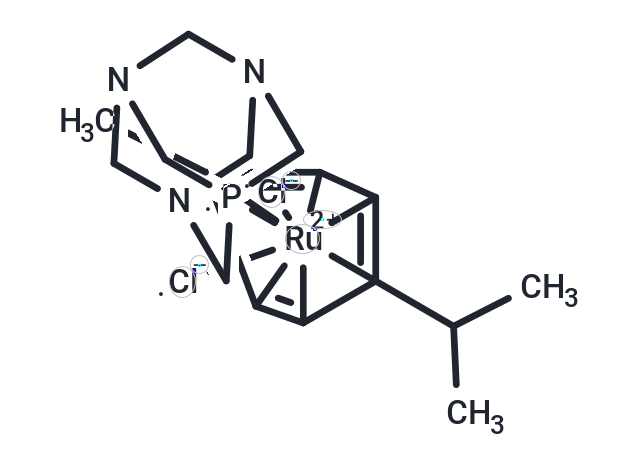
RAPTA-C
CAS No. 372948-28-2
RAPTA-C( —— )
Catalog No. M34689 CAS No. 372948-28-2
RAPTA-C induces EAC cell cycle arrest and apoptosis via the mitochondrial and p53-JNK pathways, and can be used in the study of breast and ovarian cancer.
Purity : >98% (HPLC)
 COA
Datasheet
HNMR
HPLC
MSDS
Handing Instructions
COA
Datasheet
HNMR
HPLC
MSDS
Handing Instructions
| Size | Price / USD | Stock | Quantity |
| 2MG | 603 | Get Quote |


|
| 5MG | 922 | Get Quote |
|
| 10MG | 1226 | Get Quote |
|
| 25MG | 1794 | Get Quote |
|
| 50MG | 2410 | Get Quote |
|
| 100MG | 3177 | Get Quote |
|
| 500MG | Get Quote | Get Quote |
|
| 1G | Get Quote | Get Quote |
|
Biological Information
-
Product NameRAPTA-C
-
NoteResearch use only, not for human use.
-
Brief DescriptionRAPTA-C induces EAC cell cycle arrest and apoptosis via the mitochondrial and p53-JNK pathways, and can be used in the study of breast and ovarian cancer.
-
DescriptionRAPTA-C induces EAC cell cycle arrest and apoptosis via the mitochondrial and p53-JNK pathways, and can be used in the study of breast and ovarian cancer.
-
In Vitro——
-
In Vivo——
-
Synonyms——
-
PathwayApoptosis
-
TargetApoptosis
-
RecptorApoptosis
-
Research Area——
-
Indication——
Chemical Information
-
CAS Number372948-28-2
-
Formula Weight463.35
-
Molecular FormulaC16H26Cl2N3PRu
-
Purity>98% (HPLC)
-
Solubility——
-
SMILES[Cl-][Ru+2]12345([Cl-])([CH]=6[CH]5=C4(C(C)C)[CH]3=[CH]2C61C)[P]78CN9CN(CN(C9)C7)C8
-
Chemical Name——
Shipping & Storage Information
-
Storage(-20℃)
-
ShippingWith Ice Pack
-
Stability≥ 2 years
Reference
molnova catalog



related products
-
Oxypalmatine
Oxypalmatine (8-Oxypalmatine) is a berberine-type alkaloid isolated from Phellodendron amurense that regulates breast cancer cell proliferation and apoptosis by inhibiting PI3K/AKT signaling and its efficacy in breast cancer-like organs.
-
Lysophosphatidylchol...
Lysophosphatidylcholines (Lyso-Lecithins (egg)) are orally active lipids that induce cell damage and apoptosis, and induce demyelination.
-
DB2313
DB2313 is a potent transcription factor PU.1 inhibitor, IC50=14 nM. DB2313 disrupts the interaction of PU.1 with target gene promoters. DB2313 induces apoptosis of acute myeloid leukemia (AML) cells, and has anticancer effects
