


 Cart
Cart
 sales@molnova.com


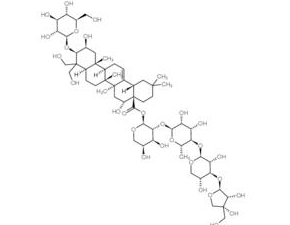
Platycodin D
CAS No. 58479-68-8
Platycodin D( —— )
Catalog No. M18847 CAS No. 58479-68-8
Platycodin D may stimulate TNF-α synthesis or inhibit degradation of TNF-α mRNA. Platycodin D (10/30 μM) suppresses prostaglandin E2 production in rat peritoneal macrophages stimulated by the protein kinase C activator 12-O-tetradecanoyl phorbol 13-acetate (TPA).
Purity : >98% (HPLC)
 COA
Datasheet
HNMR
HPLC
MSDS
Handing Instructions
COA
Datasheet
HNMR
HPLC
MSDS
Handing Instructions
| Size | Price / USD | Stock | Quantity |
| 5MG | 47 | In Stock |


|
| 10MG | 80 | In Stock |
|
| 25MG | 140 | In Stock |
|
| 50MG | 214 | In Stock |
|
| 100MG | 357 | In Stock |
|
| 500MG | 804 | In Stock |
|
| 1G | Get Quote | In Stock |
|
Biological Information
-
Product NamePlatycodin D
-
NoteResearch use only, not for human use.
-
Brief DescriptionPlatycodin D may stimulate TNF-α synthesis or inhibit degradation of TNF-α mRNA. Platycodin D (10/30 μM) suppresses prostaglandin E2 production in rat peritoneal macrophages stimulated by the protein kinase C activator 12-O-tetradecanoyl phorbol 13-acetate (TPA).
-
DescriptionPlatycodin D may stimulate TNF-α synthesis or inhibit degradation of TNF-α mRNA. Platycodin D (10/30 μM) suppresses prostaglandin E2 production in rat peritoneal macrophages stimulated by the protein kinase C activator 12-O-tetradecanoyl phorbol 13-acetate (TPA). Platycodin D and D3 are useful as expectorant agents in the treatment of various airway diseases, they can increase mucin release from rat and hamster tracheal surface epithelial cell culture and also from intact rat trachea upon nebulization.
-
In Vitro——
-
In VivoAnimal Model:Genetically obese db/db mice Dosage:5 mg/kg Administration:Oral administration; 5 mg/kg, 5 times per week for 5 weeks Result:Significantly decreased body weight gain without affecting food intake of mice. Decreased the liver tissue weight and increased the weight of brown adipose tissue (BAT).
-
Synonyms——
-
PathwayEndocrinology/Hormones
-
TargetAChR
-
RecptorPGE2
-
Research AreaOthers-Field
-
Indication——
Chemical Information
-
CAS Number58479-68-8
-
Formula Weight1225.34
-
Molecular FormulaC57H92O28
-
Purity>98% (HPLC)
-
SolubilityIn Vitro:?DMSO : 50 mg/mL (40.81 mM)
-
SMILESC1C(CC[C@@]2([C@@H](C[C@@]3([C@@]4(CC[C@H]5C([C@H]([C@H](C[C@@]5(C4CC=C3[C@H]12)C)O)O[C@@H]1O[C@@H]([C@H]([C@@H]([C@H]1O)O)O)CO)(CO)CO)C)C)O)C(=O)O[C@@H]1OC[C@@H]([C@@H]([C@H]1O[C@@H]1O[C@H]([C@@H]([C@H]([C@H]1O)O)O[C@@H]1OC[C@H]([C@@H]([C@H]1O)O[C@@H]1OC[C@@]([C@H]1O)(CO)O)O)C)O)O)(C)C
-
Chemical Name——
Shipping & Storage Information
-
Storage(-20℃)
-
ShippingWith Ice Pack
-
Stability≥ 2 years
Reference
1. Kwon OG,ET AL. The Effects of Platycodin D, a Saponin Purified from Platycodi Radix, on Collagen-Induced DBA/1J Mouse Rheumatoid Arthritis. Evid Based Complement Alternat Med. 2014;2014:954508.
molnova catalog



related products
-
nAChR agonist 1
nAChR agonist 1 is a brain-permeable and?orally?efficacious positive?allosteric? α7?nicotinic?acetylcholine?receptor (α7 nAChR)modulator.
-
2,3-Dihydrobenzofura...
2,3-Dihydrobenzofuran is an acetylcholinesterase (AChE) inhibitor isolated from leaves of L. camara.?Coumaran can be used as a biopesticide.?2,3-dihydrobenzofuran is a member of the class of 1-benzofurans that is the 2,3-dihydroderivative of benzofuran.?It has a role as a metabolite.The in vitro inhibition of acetylcholinesterase was increased with the concentration of Coumaran in the housefly (head and thorax) homogenate.
-
LY 334370
LY334370 is a selective 5-HT1F receptor agonist with a Ki of 1.6 nM.
