


 Cart
Cart
 sales@molnova.com


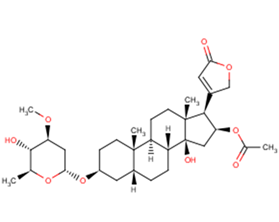
Oleandrin
CAS No. 465-16-7
Oleandrin( PBI05204 | PBI 05204 | PBI-05204 | Oleandrin )
Catalog No. M18570 CAS No. 465-16-7
Oleandrin, the principal cardiac glycoside component of PBI-524, can quantitatively account for regulation of BDNF at both the protein and transcriptional levels.
Purity : >98% (HPLC)
 COA
Datasheet
HNMR
HPLC
MSDS
Handing Instructions
COA
Datasheet
HNMR
HPLC
MSDS
Handing Instructions
| Size | Price / USD | Stock | Quantity |
| 2MG | 132 | In Stock |


|
| 5MG | 260 | In Stock |
|
| 10MG | 417 | In Stock |
|
| 25MG | 687 | In Stock |
|
| 50MG | 963 | In Stock |
|
| 100MG | 1287 | In Stock |
|
| 500MG | 2601 | In Stock |
|
| 1G | Get Quote | In Stock |
|
Biological Information
-
Product NameOleandrin
-
NoteResearch use only, not for human use.
-
Brief DescriptionOleandrin, the principal cardiac glycoside component of PBI-524, can quantitatively account for regulation of BDNF at both the protein and transcriptional levels.
-
DescriptionOleandrin, also known as PBI-05204 , is a lipid soluble cardiac glycoside with potential antineoplastic activity. Upon administration, oleandrin specifically binds to and inhibits the alpha3 subunit of the Na/K-ATPase pump in human cancer cells. This may inhibit the phosphorylation of Akt, upregulate MAPK, inhibit NF-kb activation and inhibit FGF-2 export and may downregulate mTOR thereby inhibiting p70S6K and S6 protein expression. All of this may lead to an induction of apoptosis.(In Vitro):Study of Na,K-ATPase inhibition shows an IC50 (nM) of 620 for Oleandrin. The inhibition of Na,K-ATPase by Oleandrin confirms that it likely exert its toxic effect through inhibition of sodium pump activity. When treated with a series of concentrations of Oleandrin (0.2-25 nM), the undifferentiated CaCO-2 cells are sensitive as evidenced by an IC50 of 8.25 nM. In contrast, a maximum growth inhibition of only 20% is reached in differentiated CaCO-2 cells even though they are treated with Oleandrin concentrations as high as 25 nM.(In Vivo):The effect of Oleandrin is investigated on glioma growth in vivo. To this aim, SCID or C57BL/6 mice are transplanted, respectively, with human U87MG (5×10⁴), U251, GBM19 (5×10⁵), or murine (syngeneic) GL261 (7.5×10⁴) cells into the right striatum and, after 10 d, treated daily with intraperitoneal Oleandrin for an additional 7 d. Oleandrin significantly reduces tumor sizes in human and murine glioma cell models in vivo in a dose-dependent way. High concentrations of Oleandrin (3 mg/kg) are fatal in both models, as expected from the known lethal dose for rodents. Doses of Oleandrin below the lethal dose (0.3 mg/kg) significantly increase the survival time from 32.6±1.4 d to 53.8±9.6 d in mice injected with U87MG cells (n=5-11; p<0.01, log-rank test) and from 23.37±1.2 d to 34.38±3.3 d (n=5-11; p<0.01, log rank test) in mice injected with GL261 cells.
-
In VitroStudy of Na,K-ATPase inhibition shows an IC50 (nM) of 620 for Oleandrin. The inhibition of Na,K-ATPase by Oleandrin confirms that it likely exert its toxic effect through inhibition of sodium pump activity. When treated with a series of concentrations of Oleandrin (0.2-25 nM), the undifferentiated CaCO-2 cells are sensitive as evidenced by an IC50 of 8.25 nM. In contrast, a maximum growth inhibition of only 20% is reached in differentiated CaCO-2 cells even though they are treated with Oleandrin concentrations as high as 25 nM.
-
In VivoThe effect of Oleandrin is investigated on glioma growth in vivo. To this aim, SCID or C57BL/6 mice are transplanted, respectively, with human U87MG (5×10⁴), U251, GBM19 (5×10⁵), or murine (syngeneic) GL261 (7.5×10⁴) cells into the right striatum and, after 10 d, treated daily with intraperitoneal Oleandrin for an additional 7 d. Oleandrin significantly reduces tumor sizes in human and murine glioma cell models in vivo in a dose-dependent way. High concentrations of Oleandrin (3 mg/kg) are fatal in both models, as expected from the known lethal dose for rodents. Doses of Oleandrin below the lethal dose (0.3 mg/kg) significantly increase the survival time from 32.6±1.4 d to 53.8±9.6 d in mice injected with U87MG cells (n=5-11; p<0.01, log-rank test) and from 23.37±1.2 d to 34.38±3.3 d (n=5-11; p<0.01, log rank test) in mice injected with GL261 cells.
-
SynonymsPBI05204 | PBI 05204 | PBI-05204 | Oleandrin
-
PathwayAutophagy
-
TargetAutophagy
-
RecptorOthers
-
Research AreaOthers-Field
-
Indication——
Chemical Information
-
CAS Number465-16-7
-
Formula Weight576.72
-
Molecular FormulaC32H48O9
-
Purity>98% (HPLC)
-
SolubilityIn Vitro:?DMSO : 100 mg/mL (173.39 mM)
-
SMILESCC1C(C(CC(O1)OC2CCC3(C(C2)CCC4C3CCC5(C4(CC(C5C6=CC(=O)OC6)OC(=O)C)O)C)C)OC)O
-
Chemical Name(3S,5R,9S,10S,13R,14S,16S)-14-hydroxy-3-(((2R,4S,5S,6S)-5-hydroxy-4-methoxy-6-methyltetrahydro-2H-pyran-2-yl)oxy)-10,13-dimethyl-17-(5-oxo-2,5-dihydrofuran-3-yl)hexadecahydro-1H-cyclopenta[a]phenanthren-16-yl acetate
Shipping & Storage Information
-
Storage(-20℃)
-
ShippingWith Ice Pack
-
Stability≥ 2 years
Reference
molnova catalog



related products
-
Pennogenin 3-O-beta-...
Pennogenin 3-O-beta-chacotrioside is an active component isolated from Paris polyphylla with anti-colorectal cancer activity. It modulates autophagy via increasing the expressions of autophagy-related proteins LC3 and Beclin-1.
-
BRD5631
A small-molecule enhancer of autophagy through an mTOR-independent pathway; significantly reduces the number of eGFP-HDQ74-positive cells, and increases the transcript level of p62 in Atg5+/+ MEFs.
-
CUR5g
CUR5g is an autophagy inhibitor that inhibits migration and colony formation in A549 cells and acts through a UVRAG-dependent mechanism by blocking the recruitment of STX17 to autophagosomes.
