


 Cart
Cart
 sales@molnova.com


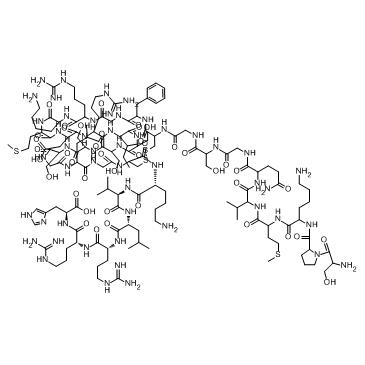
Nesiritide
CAS No. 124584-08-3
Nesiritide( Brain Natriuretic Peptide-32 human; BNP-32 )
Catalog No. M29907 CAS No. 124584-08-3
Nesiritide is the recombinant form of the 32 amino acid human B-type natriuretic peptide, which is normally produced by the ventricular myocardium. It is an agonist of natriuretic peptide receptors (NPRs), with Kd values of 7.3 and 13 pM for NPR-A and NPR-C, respectively.
Purity : >98% (HPLC)
 COA
Datasheet
HNMR
HPLC
MSDS
Handing Instructions
COA
Datasheet
HNMR
HPLC
MSDS
Handing Instructions
| Size | Price / USD | Stock | Quantity |
| 5MG | 761 | Get Quote |


|
| 10MG | 1158 | Get Quote |
|
| 100MG | Get Quote | Get Quote |
|
| 200MG | Get Quote | Get Quote |
|
| 500MG | Get Quote | Get Quote |
|
Biological Information
-
Product NameNesiritide
-
NoteResearch use only, not for human use.
-
Brief DescriptionNesiritide is the recombinant form of the 32 amino acid human B-type natriuretic peptide, which is normally produced by the ventricular myocardium. It is an agonist of natriuretic peptide receptors (NPRs), with Kd values of 7.3 and 13 pM for NPR-A and NPR-C, respectively.
-
DescriptionNesiritide is the recombinant form of the 32 amino acid human B-type natriuretic peptide, which is normally produced by the ventricular myocardium. It is an agonist of natriuretic peptide receptors (NPRs), with Kd values of 7.3 and 13 pM for NPR-A and NPR-C, respectively.(In Vitro):Nesiritide is an agonist of natriuretic peptide receptor (NPR), with Kd values of 7.3 and 13 pM for NPR-A and NPR-C, respectively. ProBNP1-108 stimulates guanylyl cyclase-A (GC-A) to near-maximum activities but is 13-fold less potent than Nesiritide (BNP1-32). ProBNP1-108 binds human GC-A 35-fold less tightly than Nesiritide. Neither proBNP1–108 nor Nesiritide activates GC-B. The natriuretic peptide clearance receptor binds proBNP1-108 3-fold less tightly than Nesiritide. The half time for degradation of proBNP1-108 by human kidney membranes is 2.7-fold longer than for Nesiritide, and the time required for complete degradation is 6-fold longer. Nesiritide and proBNP1-108 are best fitted by first- and second-order exponential decay models, respectively.
-
In VitroNesiritide (Brain Natriuretic Peptide-32 human) is an agonist of natriuretic peptide receptor (NPR), with Kd values of 7.3 and 13 pM for NPR-A and NPR-C, respectively. ProBNP1-108 stimulates guanylyl cyclase-A (GC-A) to near-maximum activities but is 13-fold less potent than Nesiritide (BNP1-32). ProBNP1-108 binds human GC-A 35-fold less tightly than Nesiritide. Neither proBNP1–108 nor Nesiritide activates GC-B. The natriuretic peptide clearance receptor binds proBNP1-108 3-fold less tightly than Nesiritide. The half time for degradation of proBNP1-108 by human kidney membranes is 2.7-fold longer than for Nesiritide, and the time required for complete degradation is 6-fold longer. Nesiritide and proBNP1-108 are best fitted by first- and second-order exponential decay models, respectively.
-
In Vivo——
-
SynonymsBrain Natriuretic Peptide-32 human; BNP-32
-
PathwayOthers
-
TargetOther Targets
-
RecptorKd: 7.3 Pm (NPR-A), 13 pM (NPR-C)
-
Research Area——
-
Indication——
Chemical Information
-
CAS Number124584-08-3
-
Formula Weight3464.04
-
Molecular FormulaC143H244N50O42S4
-
Purity>98% (HPLC)
-
SolubilityH2O : ≥ 40 mg/mL (11.55 mM)
-
SMILES——
-
Chemical NameSequence:Ser-Pro-Lys-Met-Val-Gln-Gly-Ser-Gly-Cys-Phe-Gly-Arg-Lys-Met-Asp-Arg-Ile-Ser-Ser-Ser-Ser-Gly-Leu-Gly-Cys-Lys-Val-Leu-Arg-Arg-His (Disulfide bridge: Cys10-Cys26)
Shipping & Storage Information
-
Storage(-20℃)
-
ShippingWith Ice Pack
-
Stability≥ 2 years
Reference
Koller KJ, et al. Molecular biology of the natriuretic peptides and their receptors. Circulation. 1992 Oct;86(4):1081-8.
molnova catalog



related products
-
CLOZAPINE N-OXIDE
Clozapine N-oxide is a major metabolite of clozapine that can be detected in the earliest excretion time interval after clozapine administration.
-
ISA-2011B
ISA-2011B is an inhibitor of PIP5K1α and can be used in anticancer studies.
-
1-Methylnicotinamide...
Niacin metabolite excreted via the urinary system.
