


 Cart
Cart
 sales@molnova.com


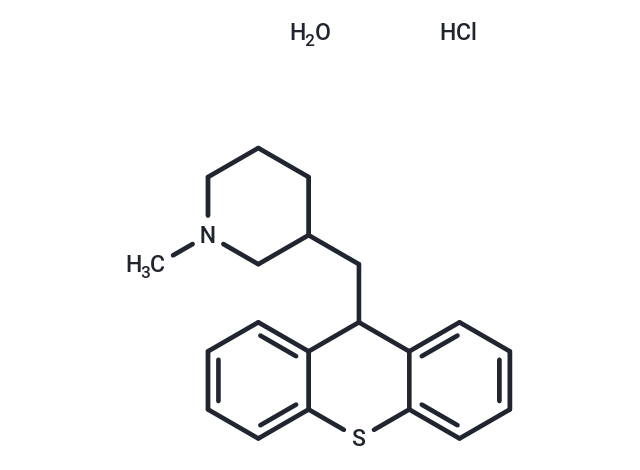
Metixene hydrochloride hydrate
CAS No. 7081-40-5
Metixene hydrochloride hydrate( —— )
Catalog No. M37950 CAS No. 7081-40-5
Metixene hydrochloride hydrate has potential anticholinergic activity and inhibits the binding of quinine ring benzoate (QNB) to muscarine receptors, with IC50 and Ki values of 55 nM and 15 nM, respectively.
Purity : >98% (HPLC)
 COA
Datasheet
HNMR
HPLC
MSDS
Handing Instructions
COA
Datasheet
HNMR
HPLC
MSDS
Handing Instructions
| Size | Price / USD | Stock | Quantity |
| 1 mL x 10 mM in DMSO | 35 | In Stock |


|
| 10MG | 31 | In Stock |
|
| 25MG | 65 | In Stock |
|
| 50MG | 100 | In Stock |
|
| 100MG | 161 | In Stock |
|
| 200MG | Get Quote | In Stock |
|
| 500MG | Get Quote | In Stock |
|
| 1G | Get Quote | In Stock |
|
Biological Information
-
Product NameMetixene hydrochloride hydrate
-
NoteResearch use only, not for human use.
-
Brief DescriptionMetixene hydrochloride hydrate has potential anticholinergic activity and inhibits the binding of quinine ring benzoate (QNB) to muscarine receptors, with IC50 and Ki values of 55 nM and 15 nM, respectively.
-
DescriptionMetixene (Piperidine) hydrochloride hydrate is an anticholinergic and antiparkinsonian agent. Metixene hydrochloride hydrate potently inhibits binding of quinuclidinyl benzilate (QNB) with the muscarinic receptor, IC50 and Ki values of 55 nM and 15 nM, respectively. Metixene hydrochloride hydrate can be used for the research of parkinsonian.
-
In VitroMetixene hydrochloride hydrate can potentially inhibit the binding of QNB with the muscarinic receptor, IC50 and Ki values of 55 nM and 15 nM, respectively.
-
In Vivo——
-
Synonyms——
-
PathwayCell Cycle/DNA Damage
-
TargetAChR
-
RecptorAChR
-
Research Area——
-
Indication——
Chemical Information
-
CAS Number7081-40-5
-
Formula Weight363.95
-
Molecular FormulaC20H26ClNOS
-
Purity>98% (HPLC)
-
SolubilityIn Vitro:?DMSO : 77.5 mg/mL (212.95 mM; Ultrasonic )H2O : 10 mg/mL (27.48 mM; Ultrasonic)
-
SMILESO.Cl.CN1CCCC(CC2c3ccccc3Sc3ccccc23)C1
-
Chemical Name——
Shipping & Storage Information
-
Storage(-20℃)
-
ShippingWith Ice Pack
-
Stability≥ 2 years
Reference
1. J. Hagenah, et al. Exogenous levodopa is not toxic to elderly subjects with non-parkinsonian movement disorders: further clinical evidence. , 106(3-4), 301–307. doi:10.1007/s007020050159
molnova catalog



related products
-
7-O-Methyleriodictyo...
7-O-Methyleriodictyol is a flavanone isolated from Artemisia monosperma and shows biological effects on rat isolated smooth muscles.
-
TMPH
TMPH is an inhibitor of nAChR and inhibits nAChRs lacking α5, α6, or β3 subunits. TMPH can be used in studies about nAChR dysfunction or neurological disorders.
-
Tiotropium Bromide h...
Tiotropium Bromide hydrate (BA-679 BR hydrate) is a potent anticholinergic and bronchodilator, serving as a muscarinic receptor antagonist, specifically targeting mAChR.
