


 Cart
Cart
 sales@molnova.com


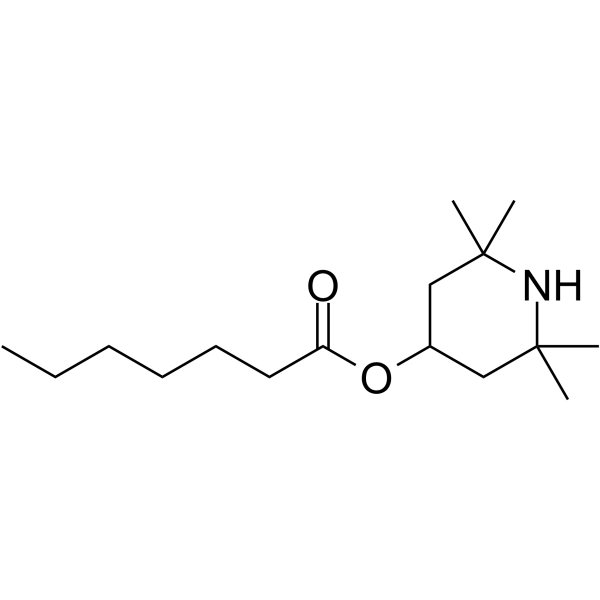
TMPH
CAS No. 849461-90-1
TMPH( 2,2,6,6-Tetramethylpiperidin-4-yl heptanoate )
Catalog No. M28531 CAS No. 849461-90-1
TMPH is an inhibitor of nAChR and inhibits nAChRs lacking α5, α6, or β3 subunits. TMPH can be used in studies about nAChR dysfunction or neurological disorders.
Purity : >98% (HPLC)
 COA
Datasheet
HNMR
HPLC
MSDS
Handing Instructions
COA
Datasheet
HNMR
HPLC
MSDS
Handing Instructions
| Size | Price / USD | Stock | Quantity |
| 1 mL x 10 mM in DMSO | 49 | In Stock |


|
| 2MG | 30 | In Stock |
|
| 5MG | 50 | In Stock |
|
| 10MG | 76 | In Stock |
|
| 25MG | 136 | In Stock |
|
| 50MG | 211 | In Stock |
|
| 100MG | 312 | In Stock |
|
| 200MG | 440 | In Stock |
|
| 500MG | Get Quote | In Stock |
|
| 1G | Get Quote | In Stock |
|
Biological Information
-
Product NameTMPH
-
NoteResearch use only, not for human use.
-
Brief DescriptionTMPH is an inhibitor of nAChR and inhibits nAChRs lacking α5, α6, or β3 subunits. TMPH can be used in studies about nAChR dysfunction or neurological disorders.
-
DescriptionTMPH is an inhibitor of nAChR and inhibits nAChRs lacking α5, α6, or β3 subunits. TMPH can be used in studies about nAChR dysfunction or neurological disorders.(In Vitro):TMPH (100 nM) inhibits nAChR with an inhibition rate of 90% in Xenopus oocytes and suppresses AChR subtypes with IC50s of 1.0-390 nM.(In Vivo):In the nicotine-induced mice model, nAChR-IN-1 (20 mg/kg; s.c.) increases locomotor activity without effects on body temperature. In the tail-flick and hot-plate mice model, nAChR-IN-1(0, 0.1, 1, 5 mg/kg; s.c.) blocks the antinociceptive effect of nicotine in the hot-plate and blocks antinociception in a time-dependent manner.
-
In VitronAChR-IN-1 (100 nM) inhibits nAChR with inhibition rate of 90% in Xenovus oocytes, and suppresses AChR subtypes (mouse muscle-type (α1β1εδ) nAChR, three different pairwise combinations of rat neuronal alpha and beta subunits (α3β4, α4β2, and α3β2), and α7 homomeric neuronal nAChR) with IC50s (area) of 390, 1.2, 110, 75, 440, 460, 430, 2.7, 1.0, 1.4, and 18.3 nM, respectively, based on the decrease in the net charge of the ACh response.
-
In VivonAChR-IN-1 (20 mg/kg; s.c.; single dose) improves nicotine-induced hypomotility and hypothermia in a time-dependent manner in mice. Animal Model:Nicotine-induced mice model Dosage:20 mg/kg Administration:Subcutaneous injection; single dose; 15 minutes prior to the injection of nicotine (1.5 mg/kg)?Result:Increased locomotor activity in mice, even if nicotine-induced decrease.Showed no effect on body temperature.Animal Model:Tail-flick and hot-platemodel in miceDosage:0, 0.1, 1, 5 mg/kg Administration:Subcutaneous injection; single dose Result:Blocked the antinociceptive effect of nicotine in the hot-plate.Time-dependently blocked nicotine-induced antinociception.
-
Synonyms2,2,6,6-Tetramethylpiperidin-4-yl heptanoate
-
PathwayCell Cycle/DNA Damage
-
TargetAChR
-
Recptor——
-
Research Area——
-
Indication——
Chemical Information
-
CAS Number849461-90-1
-
Formula Weight269.42
-
Molecular FormulaC16H31NO2
-
Purity>98% (HPLC)
-
SolubilityIn Vitro:?DMSO : 100 mg/mL (371.17 mM)
-
SMILESO=C(OC1CC(NC(C)(C)C1)(C)C)CCCCCC
-
Chemical Name——
Shipping & Storage Information
-
Storage(-20℃)
-
ShippingWith Ice Pack
-
Stability≥ 2 years
Reference
molnova catalog



related products
-
(-)-Coclaurine hydro...
(-)-Coclaurine hydrochloride is an antagonist of nAChRs isolated from Sarcopetalum harveyanum.
-
YM-58790
YM-58790 free base is a potent mAChR antagonist that inhibits M1 mAChR, M2 mAChR, and M3 mAChR with Ki values of 28 nM, 260 nM, and 15 nM, respectively.
-
9-Ethyladenine
9-Ethyladenine is a partially effective inhibitor of APRT (adenine phosphoribosyltransferase).
