


 Cart
Cart
 sales@molnova.com


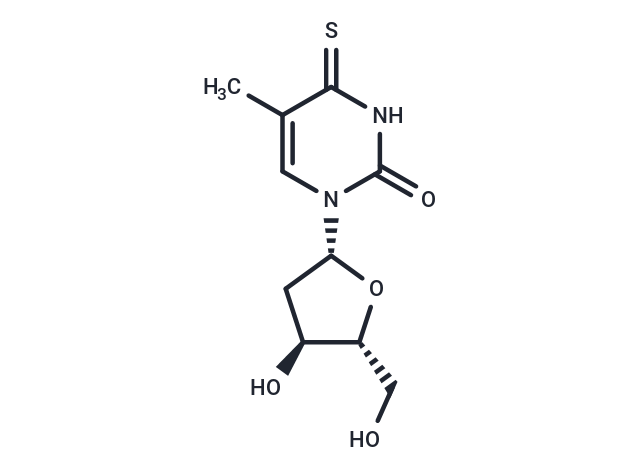
4-Thiothymidine
CAS No. 7236-57-9
4-Thiothymidine( —— )
Catalog No. M37905 CAS No. 7236-57-9
4-Thiothymidine is a Nucleoside Derivative - Thio-nucleoside, 5-Modified pyrimidine nucleoside.
Purity : >98% (HPLC)
 COA
Datasheet
HNMR
HPLC
MSDS
Handing Instructions
COA
Datasheet
HNMR
HPLC
MSDS
Handing Instructions
| Size | Price / USD | Stock | Quantity |
| 1 mL x 10 mM in DMSO | 28 | In Stock |


|
| 100MG | 38 | In Stock |
|
| 200MG | Get Quote | In Stock |
|
| 500MG | Get Quote | In Stock |
|
| 1G | Get Quote | In Stock |
|
Biological Information
-
Product Name4-Thiothymidine
-
NoteResearch use only, not for human use.
-
Brief Description4-Thiothymidine is a Nucleoside Derivative - Thio-nucleoside, 5-Modified pyrimidine nucleoside.
-
Description4-Thiothymidine is a purine nucleoside analog. Purine nucleoside analogs have broad antitumor activity targeting indolent lymphoid malignancies. Anticancer mechanisms in this process rely on inhibition of DNA synthesis, induction of apoptosis, etc.
-
In Vitro——
-
In Vivo——
-
Synonyms——
-
PathwayApoptosis
-
TargetApoptosis
-
RecptorApoptosis
-
Research Area——
-
Indication——
Chemical Information
-
CAS Number7236-57-9
-
Formula Weight258.29
-
Molecular FormulaC10H14N2O4S
-
Purity>98% (HPLC)
-
Solubility——
-
SMILESO=C1N([C@@H]2O[C@H](CO)[C@@H](O)C2)C=C(C)C(=S)N1
-
Chemical Name——
Shipping & Storage Information
-
Storage(-20℃)
-
ShippingWith Ice Pack
-
Stability≥ 2 years
Reference
1. Robak T, Robak P. Purine nucleoside analogs in the treatment of rarer chronic lymphoid leukemias. Curr Pharm Des. 2012;18(23):3373-88.?
molnova catalog



related products
-
MKC-1
MKC-1 is an orally bioavailable, small-molecule, bisindolylmaleimide cell cycle inhibitor with potential antineoplastic activity. MKC-1 and its metabolites inhibit tubulin polymerization, blocking the formation of the mitotic spindle.
-
Flavokawain B
Flavokawain B is a natural chalcone that can induce apoptosis in androgen receptor-negative, hormone-refractory prostate cancer cell lines (IC50=3-50 uM).
-
Sulforaphene
Sulforaphene, isolated from radish seeds, exhibits an ED50 against velvetleaf seedlings approximately 2 x 10⁻⁴ M.
