


 Cart
Cart
 sales@molnova.com


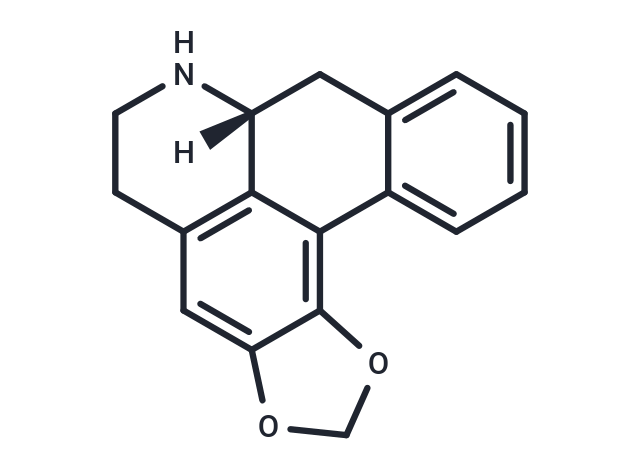
(-)-Anonaine
CAS No. 1862-41-5
(-)-Anonaine( —— )
Catalog No. M37730 CAS No. 1862-41-5
(-)-Anonaine can be extracted from several species of Magnoliaceae and Annelidae and has antimalarial, antibacterial, antifungal, antioxidant, anticancer, antidepressant and vasodilatory activities.
Purity : >98% (HPLC)
 COA
Datasheet
HNMR
HPLC
MSDS
Handing Instructions
COA
Datasheet
HNMR
HPLC
MSDS
Handing Instructions
| Size | Price / USD | Stock | Quantity |
| 1 mL x 10 mM in DMSO | 922 | In Stock |


|
| 5MG | 771 | In Stock |
|
| 10MG | 1036 | In Stock |
|
| 25MG | 1511 | In Stock |
|
| 50MG | 1841 | In Stock |
|
| 100MG | 2325 | In Stock |
|
| 200MG | Get Quote | In Stock |
|
| 500MG | 4557 | In Stock |
|
| 1G | Get Quote | In Stock |
|
Biological Information
-
Product Name(-)-Anonaine
-
NoteResearch use only, not for human use.
-
Brief Description(-)-Anonaine can be extracted from several species of Magnoliaceae and Annelidae and has antimalarial, antibacterial, antifungal, antioxidant, anticancer, antidepressant and vasodilatory activities.
-
DescriptionAnonaine is an antiparasitic agent. Anonaine also is a glutathione S-transferase (GST) inhibitor.
-
In Vitro——
-
In Vivo——
-
Synonyms——
-
PathwayApoptosis
-
TargetApoptosis
-
RecptorApoptosis | Antioxidant | Parasite | Antifungal
-
Research Area——
-
Indication——
Chemical Information
-
CAS Number1862-41-5
-
Formula Weight265.31
-
Molecular FormulaC17H15NO2
-
Purity>98% (HPLC)
-
Solubility——
-
SMILESC=12C3=C4C(=CC1CCN[C@@]2(CC=5C3=CC=CC5)[H])OCO4
-
Chemical Name——
Shipping & Storage Information
-
Storage(-20℃)
-
ShippingWith Ice Pack
-
Stability≥ 2 years
Reference
1. Bezerra WADS, et al. Anonaine from Annona crassiflora inhibits glutathione S-transferase and improves cypermethrin activity on Rhipicephalus (Boophilus) microplus (Canestrini, 1887). Exp Parasitol. 2022 Dec;243:108398. ?
molnova catalog



related products
-
DCH36_06
DCH36_06? as a bona fide is a potent p300/CBP inhibitor
-
ZNL 02-096
ZNL 02-096 (Pomalidomide-C3-adavosertib) is a rapid and selective degrader of Wee1 (IC50=3.58 nM).
-
Gliotoxin
Gliotoxin, a Wnt signaling pathway inhibitor, induces growth inhibition and apoptosis in multiple colorectal cancer cell lines with mutations of the Wnt signaling pathway.
