


 Cart
Cart
 sales@molnova.com


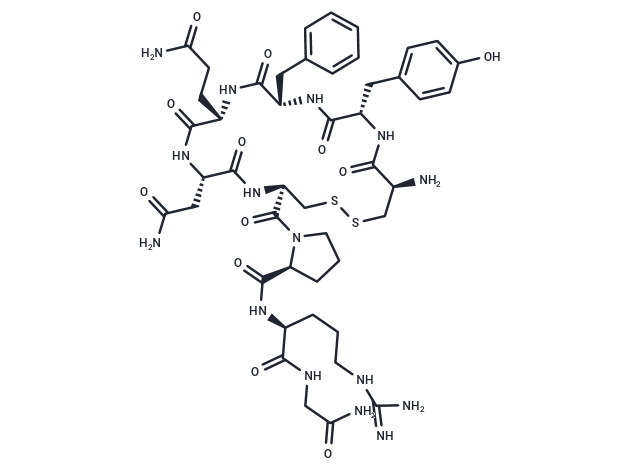
Vasopressin
CAS No. 11000-17-2
Vasopressin( —— )
Catalog No. M37685 CAS No. 11000-17-2
Vasopressin (argipressin), a cyclic nine-peptide synthesized by hypothalamic neurons, is one of the hormones involved in peptide prohormone synthesis.
Purity : >98% (HPLC)
 COA
Datasheet
HNMR
HPLC
MSDS
Handing Instructions
COA
Datasheet
HNMR
HPLC
MSDS
Handing Instructions
| Size | Price / USD | Stock | Quantity |
| 1 mL x 10 mM in DMSO | 74 | In Stock |


|
| 5MG | 37 | In Stock |
|
| 10MG | 61 | In Stock |
|
| 25MG | 92 | In Stock |
|
| 50MG | 152 | In Stock |
|
| 100MG | Get Quote | In Stock |
|
| 200MG | Get Quote | In Stock |
|
| 500MG | Get Quote | In Stock |
|
| 1G | Get Quote | In Stock |
|
Biological Information
-
Product NameVasopressin
-
NoteResearch use only, not for human use.
-
Brief DescriptionVasopressin (argipressin), a cyclic nine-peptide synthesized by hypothalamic neurons, is one of the hormones involved in peptide prohormone synthesis.
-
DescriptionVasopressin is a cyclic nonapeptide that is synthesized centrally in the hypothalamus. Vasopressin participates in the hypothalamic-pituitary-adrenal axis, and regulates pituitary corticotropin secretion by potentiating the stimulatory effects of corticotropin releasing factor. Vasopressin also can act as a neurotransmitter, exerting its action by binding to specific G protein-coupled receptors.
-
In VitroAVP (0.01 nM-1 μM) induces Ca2+ increase in Chinese hamster ovary cells expressing rat or human V1b receptors.
-
In VivoVasopressin (0.03-0.3μg/kg; i.p.) potentiates corticotropin release provoked by exogenous corticoliberin and increases corticotropin secretion subsequent to body water loss.Vasopressin (0.001-0.1?mg/kg; i.p.) potently increases adjacent lying, where rats meeting for the first time lie passively next to each other.
-
Synonyms——
-
PathwayProteasome/Ubiquitin
-
TargetEndogenous Metabolite
-
RecptorEndogenous Metabolite
-
Research Area——
-
Indication——
Chemical Information
-
CAS Number11000-17-2
-
Formula Weight1084.24
-
Molecular FormulaC46H65N15O12S2
-
Purity>98% (HPLC)
-
SolubilityIn Vitro:?DMSO : 100 mg/mL (92.23 mM; Ultrasonic ) H2O : 50 mg/mL (46.12 mM; Ultrasonic)
-
SMILESO=C([C@@H](N)CSSC[C@H](NC1=O)C(N2[C@H](C(N[C@H](C(NCC(N)=O)=O)CCCNC(N)=N)=O)CCC2)=O)N[C@H](C(N[C@H](C(N[C@H](C(N[C@H]1CC(N)=O)=O)CCC(N)=O)=O)CC3=CC=CC=C3)=O)CC4=CC=C(O)C=C4
-
Chemical Name——
Shipping & Storage Information
-
Storage(-20℃)
-
ShippingWith Ice Pack
-
Stability≥ 2 years
Reference
1. Baribeau DA, et, al. Oxytocin and vasopressin: linking pituitary neuropeptides and their receptors to social neurocircuits. Front Neurosci. 2015 Sep 24;9:335.?
molnova catalog



related products
-
5a-Pregnane-320-dion...
5a-Pregnane-320-dione is a biologically active 5-alpha-reduced metabolite of plasma progesterone
-
5,6-Dihydroxyindole
5,6-Dihydroxyindole (Dopamine lutine) is a melanin precursor and has a broad-spectrum antibacterial, antiviral, antifungal, antiparasitic activity.
-
p-Toluic Acid
p-Toluic Acid belongs to the class of organic compounds known as benzoic acids. 4-Methylbenzoic acid has been primarily detected in saliva.
