


 Cart
Cart
 sales@molnova.com


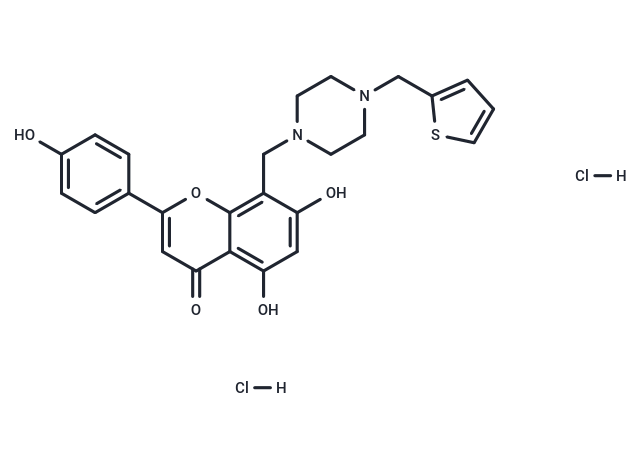
PARP1-IN-5 dihydrochloride?
CAS No. 2823308-89-8
PARP1-IN-5 dihydrochloride?( —— )
Catalog No. M37639 CAS No. 2823308-89-8
PARP1-IN-5 dihydrochloride is an orally active, potent and selective PARP-1 inhibitor (IC50 =14.7 nM). PARP1-IN-5 dihydrochloride can be used for the research of cancer.
Purity : >98% (HPLC)
 COA
Datasheet
HNMR
HPLC
MSDS
Handing Instructions
COA
Datasheet
HNMR
HPLC
MSDS
Handing Instructions
| Size | Price / USD | Stock | Quantity |
| 1 mL x 10 mM in DMSO | 231 | In Stock |


|
| 5MG | 188 | In Stock |
|
| 10MG | 297 | In Stock |
|
| 25MG | 591 | In Stock |
|
| 50MG | 811 | In Stock |
|
| 100MG | Get Quote | In Stock |
|
| 200MG | Get Quote | In Stock |
|
| 500MG | Get Quote | In Stock |
|
| 1G | Get Quote | In Stock |
|
Biological Information
-
Product NamePARP1-IN-5 dihydrochloride?
-
NoteResearch use only, not for human use.
-
Brief DescriptionPARP1-IN-5 dihydrochloride is an orally active, potent and selective PARP-1 inhibitor (IC50 =14.7 nM). PARP1-IN-5 dihydrochloride can be used for the research of cancer.
-
DescriptionPARP1-IN-5 dihydrochloride is a low toxicity, orally active, potent and selective PARP-1 inhibitor (IC50 =14.7 nM). PARP1-IN-5 dihydrochloride can be used for the research of cancer.
-
In VitroPARP1-IN-5 dihydrochloride (0.1~10 μM; A549 cells) can significantly increase the cytotoxicity of CBP on A549 cells in a dose-dependent manner. PARP1-IN-5 dihydrochloride (0.1~10 μM; SK-OV-3 cells) decreases the expressions of MCM2-7. PARP1-IN-5 dihydrochloride (0.1~320 μM; A549 cells) has little cytotoxic effects on A549 cells. PARP1-IN-5 dihydrochloride (SK-OV-3 cells) can significantly decrease the PAR level.PARP1-IN-5 dihydrochloride exerts antitumor effects through PARP-1. PARP1-IN-5 dihydrochloride could increase the γ-H2AX expression.
-
In VivoPARP1-IN-5 dihydrochloride (1000 mg/kg; p.o.) shows that there is no significant difference in the body weight and blood routine.PARP1-IN-5 dihydrochloride (25 and 50 mg/kg; p.o.; 12 days) significantly enhances the inhibitory effect of carboplatin on A549 cells at 50 mg/kg.PARP1-IN-5 dihydrochloride (50 mg/kg; p.o.) positively correlates with the expression of PARP-1.PARP1-IN-5 dihydrochloride can upregulate the expression of γ-H2AX and decrease the expression of PAR.Animal Model:Mice Dosage:1000 mg/kg Administration:P.o.Result:There was no significant difference in the body weight and blood routine.Animal Model:Mice Dosage:25 and 50 mg/kg Administration:P.o.; 12 days Result:Significantly enhanced the inhibitory effect of CBP on A549 cells at 50 mg/kg.Animal Model:Male Sprague?Dawley (SD) rats Dosage:50 mg/kg (Pharmacokinetic Analysis)Administration:P.o.Result:Positively correlated with the expression of PARP-1.
-
Synonyms——
-
PathwayCell Cycle/DNA Damage
-
TargetPARP
-
RecptorPARP
-
Research Area——
-
Indication——
Chemical Information
-
CAS Number2823308-89-8
-
Formula Weight537.46
-
Molecular FormulaC25H26Cl2N2O5S
-
Purity>98% (HPLC)
-
SolubilityIn Vitro:?DMSO : 125 mg/mL (232.58 mM; Ultrasonic )H2O : 1 mg/mL (1.86 mM; Ultrasonic (<60°C)
-
SMILESO=C1C=C(C2=CC=C(O)C=C2)OC3=C(CN4CCN(CC5=CC=CS5)CC4)C(O)=CC(O)=C31.Cl[H].Cl[H]
-
Chemical Name——
Shipping & Storage Information
-
Storage(-20℃)
-
ShippingWith Ice Pack
-
Stability≥ 2 years
Reference
1. Long H, et al. Discovery of Novel Apigenin-Piperazine Hybrids as Potent and Selective Poly (ADP-Ribose) Polymerase-1 (PARP-1) Inhibitors for the Treatment of Cancer. J Med Chem. 2021;64(16):12089-12108.?
molnova catalog



related products
-
GeA-69
GeA-69 (GeA69) is a selective and allosteric PARP14 macrodomain 2 (MD2) inhibitor (Kd: 0.86 μM in ITC assays).
-
Venadaparib
Venadaparib (IDX-1197) is a potent, selective and orally active PARP inhibitor with IC50s of 1.4 nM and 1.0 nM for PARP1 and PARP2, respectively.
-
DR 2313
DR 2313 is a competitive inhibitor of poly(ADP-ribose) polymerase (IC50: 0.20 and 0.24 μM for PARP-1 and PARP-2 respectively).
