


 Cart
Cart
 sales@molnova.com


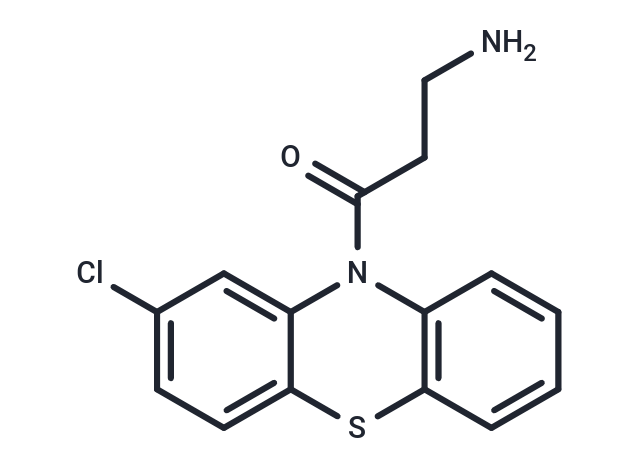
Phenothiazine Analogues
CAS No. 423749-25-1
Phenothiazine Analogues( —— )
Catalog No. M37554 CAS No. 423749-25-1
3-Amino-1-(2-chloro-10H-phenothiazin-10-yl)-1-propanone is involved in the synthesis of phenothiazine series compounds.
Purity : >98% (HPLC)
 COA
Datasheet
HNMR
HPLC
MSDS
Handing Instructions
COA
Datasheet
HNMR
HPLC
MSDS
Handing Instructions
| Size | Price / USD | Stock | Quantity |
| 5MG | 627 | In Stock |


|
| 10MG | 941 | In Stock |
|
| 25MG | 1596 | In Stock |
|
| 50MG | 2345 | In Stock |
|
| 100MG | Get Quote | In Stock |
|
| 200MG | Get Quote | In Stock |
|
| 500MG | Get Quote | In Stock |
|
| 1G | Get Quote | In Stock |
|
Biological Information
-
Product NamePhenothiazine Analogues
-
NoteResearch use only, not for human use.
-
Brief Description3-Amino-1-(2-chloro-10H-phenothiazin-10-yl)-1-propanone is involved in the synthesis of phenothiazine series compounds.
-
Description3-Amino-1-(2-chloro-10H-phenothiazin-10-yl)-1-propanone is involved in the synthesis of phenothiazine series compounds.
-
In Vitro——
-
In Vivo——
-
Synonyms——
-
PathwayOthers
-
TargetOther Targets
-
RecptorOthers
-
Research Area——
-
Indication——
Chemical Information
-
CAS Number423749-25-1
-
Formula Weight304.8
-
Molecular FormulaC15H13ClN2OS
-
Purity>98% (HPLC)
-
Solubility——
-
SMILESO=C(N1C=2C=CC=CC2SC3=CC=C(Cl)C=C31)CCN
-
Chemical Name——
Shipping & Storage Information
-
Storage(-20℃)
-
ShippingWith Ice Pack
-
Stability≥ 2 years
Reference
molnova catalog



related products
-
Kisspeptin-10, rat
Endogenous ligand for the rodent kisspeptin receptor (KISS1, GPR54).
-
3-(3-Hydroxyphenyl)p...
3-(3-Hydroxyphenyl)propionic Acid is one of the major metabolites of ingested caffeic acid.it?inhibited osteoclastogenesis and bone osteoclastic resorptive activity.
-
Nortopixantrone HCl
Nortopixantrone HCl (BBR 3438) is a novel 9-azacyclonopyrazole that shows antitumor activity in a human prostate cancer model.
