


 Cart
Cart
 sales@molnova.com


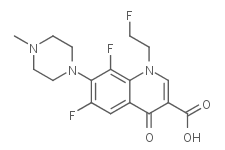
Fleroxacin
CAS No. 79660-72-3
Fleroxacin( Fleroxacin, Quinodis, Megalocin, AM-833, Ro 236240 )
Catalog No. M19364 CAS No. 79660-72-3
Fleroxacin is a broad-spectrum antimicrobial fluoroquinolone. It strongly inhibits the DNA-supercoiling activity of DNA gyrase.
Purity : >98% (HPLC)
 COA
Datasheet
HNMR
HPLC
MSDS
Handing Instructions
COA
Datasheet
HNMR
HPLC
MSDS
Handing Instructions
| Size | Price / USD | Stock | Quantity |
| 100MG | Get Quote | In Stock |


|
| 200MG | Get Quote | In Stock |
|
| 500MG | Get Quote | In Stock |
|
| 1G | 37 | In Stock |
|
Biological Information
-
Product NameFleroxacin
-
NoteResearch use only, not for human use.
-
Brief DescriptionFleroxacin is a broad-spectrum antimicrobial fluoroquinolone. It strongly inhibits the DNA-supercoiling activity of DNA gyrase.
-
DescriptionFleroxacin, a quinolone, is a bactericidal drug that inhibits bacterial DNA gyrase and topoisomerase IV. Like other quinolones and fluoroquinolones the compound eradicates bacteria by interfering with DNA replication (bacterial DNA replication, transcription, repair and recombination). Fleroxacin is active against many Gram-positive and Gram-negative bacteria.(In Vivo):Fleroxacin (Ro 23-6240) is a new trifluorinated quinolone exhibiting high activity against a broad spectrum of gram-negative and gram-positive bacteria. Fleroxacin is characterized pharmacokinetically by a long elimination half-life (9 to 10 h) and high concentrations in plasma (e.g., maximum concentration of 2.3 micrograms/ml after an oral dose of 200 mg). Fleroxacin (Ro 23-6240) is effective against Haemophilus ducreyi in vitro. Fleroxacin (Ro 23-6240), 200 or 400 mg as a single oral dose, is efficacious therapy for microbiologically proven chancroid in patients who do not have concurrent HIV-1 infection. Among HIV-1-infected men, a single dose of 200 or 400 mg of fleroxacin is inadequate therapy for chancroid.
-
In Vitro——
-
In VivoFleroxacin (Ro 23-6240) is a new trifluorinated quinolone exhibiting high activity against a broad spectrum of gram-negative and gram-positive bacteria. Fleroxacin is characterized pharmacokinetically by a long elimination half-life (9 to 10 h) and high concentrations in plasma (e.g., maximum concentration of 2.3 micrograms/ml after an oral dose of 200 mg). Fleroxacin (Ro 23-6240) is effective against Haemophilus ducreyi in vitro. Fleroxacin (Ro 23-6240), 200 or 400 mg as a single oral dose, is efficacious therapy for microbiologically proven chancroid in patients who do not have concurrent HIV-1 infection. Among HIV-1-infected men, a single dose of 200 or 400 mg of fleroxacin is inadequate therapy for chancroid.
-
SynonymsFleroxacin, Quinodis, Megalocin, AM-833, Ro 236240
-
PathwayOthers
-
TargetOther Targets
-
RecptorDNA gyrase| Topo II| Topo IV
-
Research AreaInfection
-
Indication——
Chemical Information
-
CAS Number79660-72-3
-
Formula Weight369.34
-
Molecular FormulaC17H18F3N3O3
-
Purity>98% (HPLC)
-
SolubilityDMSO : < 1 mg/mL
-
SMILESCN1CCN(CC1)C2=C(C=C3C(=C2F)N(C=C(C3=O)C(=O)O)CCF)F
-
Chemical Name6,8-difluoro-1-(2-fluoroethyl)-7-(4-methylpiperazin-1-yl)-4-oxoquinoline-3-carboxylic acid
Shipping & Storage Information
-
Storage(-20℃)
-
ShippingWith Ice Pack
-
Stability≥ 2 years
Reference
1. Hussy P, et al. Antimicrob Agents ChemOthers. 1986 Jun;29(6):1073-8.
molnova catalog



related products
-
(S )-7-O -Methylpeuc...
(S)-7-O-Methylpeucedanol 3′-O-β-D-glucopyranoside is a kind of coumarin glycoside.
-
Isocitric acid triso...
DL-Isocitric acid trisodium salt is the protonated form of isocitrate a substrate in the citric acid cycle. It is useful as a marker for determining the composition of isocitrates in fruit products including fruit juices.
-
Reptoside
Reptoside, which can be extracted from the roots and above-ground parts of Cortex Eucommiae and Ajuga chamaepitys (L.) Schreb, is one of the active cyclic enol ether terpene glycosides of Cortex Eucommiae for the treatment of osteoporosis.
