


 Cart
Cart
 sales@molnova.com


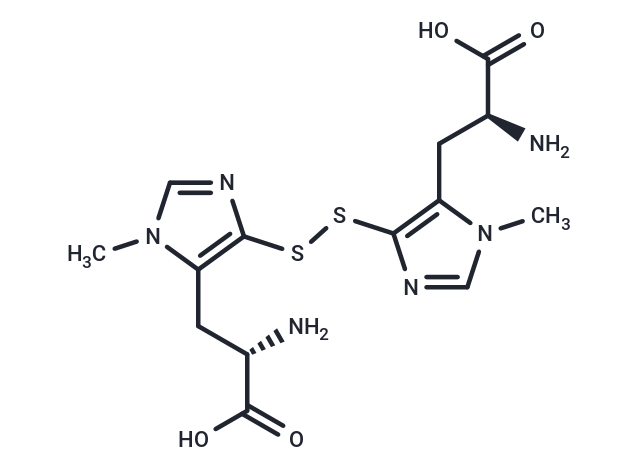
1-N-Methyl-4-mercaptohistidine disulfide
CAS No. 73491-33-5
1-N-Methyl-4-mercaptohistidine disulfide( —— )
Catalog No. M37334 CAS No. 73491-33-5
1-N-Methyl-4-mercaptohistidine disulfide is a potential Duchenne chloroplast coupling factor 1 redox regulator, an oxidized form of ochratoxin A, that inhibits light-triggered CF1 ATPase activity.
Purity : >98% (HPLC)
 COA
Datasheet
HNMR
HPLC
MSDS
Handing Instructions
COA
Datasheet
HNMR
HPLC
MSDS
Handing Instructions
| Size | Price / USD | Stock | Quantity |
| 2MG | 1669 | Get Quote |


|
| 5MG | 1397 | Get Quote |
|
| 100MG | Get Quote | Get Quote |
|
| 200MG | Get Quote | Get Quote |
|
| 500MG | Get Quote | Get Quote |
|
| 1G | Get Quote | Get Quote |
|
Biological Information
-
Product Name1-N-Methyl-4-mercaptohistidine disulfide
-
NoteResearch use only, not for human use.
-
Brief Description1-N-Methyl-4-mercaptohistidine disulfide is a potential Duchenne chloroplast coupling factor 1 redox regulator, an oxidized form of ochratoxin A, that inhibits light-triggered CF1 ATPase activity.
-
Description1-N-Methyl-4-mercaptohistidine disulfide is a potential Duchenne chloroplast coupling factor 1 redox regulator, an oxidized form of ochratoxin A, that inhibits light-triggered CF1 ATPase activity.
-
In Vitro——
-
In Vivo——
-
Synonyms——
-
PathwayOthers
-
TargetOther Targets
-
RecptorOthers
-
Research Area——
-
Indication——
Chemical Information
-
CAS Number73491-33-5
-
Formula Weight400.48
-
Molecular FormulaC14H20N6O4S2
-
Purity>98% (HPLC)
-
Solubility——
-
SMILESC([C@@H](C(O)=O)N)C1=C(SSC2=C(C[C@@H](C(O)=O)N)N(C)C=N2)N=CN1C
-
Chemical Name——
Shipping & Storage Information
-
Storage(-20℃)
-
ShippingWith Ice Pack
-
Stability≥ 2 years
Reference
molnova catalog



related products
-
Curculigoside
Curculigoside can prevent bone loss , improve osteogenesis and inhibit osteoclastogenesis of hAFSCs, suggesting its potential use to regulate hAFSC osteogenic differentiation for treating bone disorders.
-
Lactoferrin (17-41) ...
This is amino acids 17 to 41 fragment of lactoferrin, known as lactoferricin B. This peptide shows anti-fungal properties in combination of other anti-fungal agents.Candida Albicans is one of the targets of the lactoferricin B.
-
CP94253 hydrochlorid...
CP94253 hydrochloride is a potent, selective and centrally active agonist of 5-HT1B receptor with Ki of 2 nM. The Kis are 89, 49, 860, and 1600 nM for 5-HT1A, 5-HT1D, 5-HT1C and 5-HT2 receptors, respectively.
