


 Cart
Cart
 sales@molnova.com


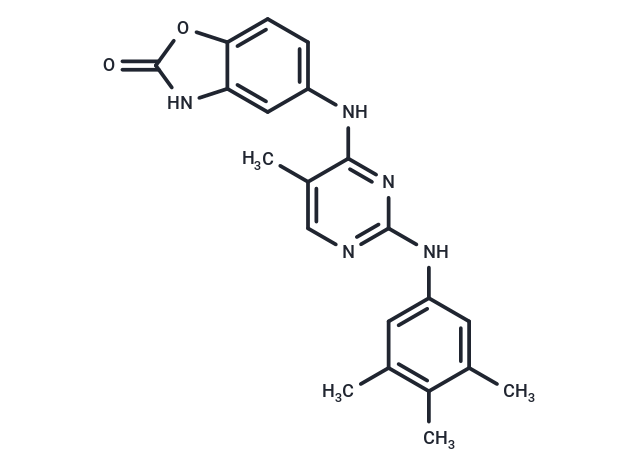
JAK-STAT-IN-1
CAS No. 1236666-76-4
JAK-STAT-IN-1( —— )
Catalog No. M37203 CAS No. 1236666-76-4
JAK-STAT-IN-1 is a specific JAK-STAT inhibitor indicated for the study of autoimmune diseases.
Purity : >98% (HPLC)
 COA
Datasheet
HNMR
HPLC
MSDS
Handing Instructions
COA
Datasheet
HNMR
HPLC
MSDS
Handing Instructions
| Size | Price / USD | Stock | Quantity |
| 5MG | 459 | In Stock |


|
| 10MG | 657 | In Stock |
|
| 25MG | 1026 | In Stock |
|
| 50MG | 1386 | In Stock |
|
| 100MG | 1832 | In Stock |
|
| 200MG | Get Quote | In Stock |
|
| 500MG | Get Quote | In Stock |
|
| 1G | Get Quote | In Stock |
|
Biological Information
-
Product NameJAK-STAT-IN-1
-
NoteResearch use only, not for human use.
-
Brief DescriptionJAK-STAT-IN-1 is a specific JAK-STAT inhibitor indicated for the study of autoimmune diseases.
-
DescriptionJAK-STAT-IN-1 (compound 1) is a selective JAK-STAT inhibitor. JAK-STAT-IN-1 can be used for the research of autoimmune disorder.
-
In Vitro——
-
In Vivo——
-
Synonyms——
-
PathwayAngiogenesis
-
TargetJAK
-
RecptorJAK | STAT
-
Research Area——
-
Indication——
Chemical Information
-
CAS Number1236666-76-4
-
Formula Weight375.42
-
Molecular FormulaC21H21N5O2
-
Purity>98% (HPLC)
-
Solubility——
-
SMILESO=C1OC2=CC=C(C=C2N1)NC3=NC(=NC=C3C)NC=4C=C(C(=C(C4)C)C)C
-
Chemical Name——
Shipping & Storage Information
-
Storage(-20℃)
-
ShippingWith Ice Pack
-
Stability≥ 2 years
Reference
1. Llinas A , et al. Derisking Development by a Cocrystallization Screen of a Novel Selective Inhaled JAK-STAT inhibitor[J].Crystal Growth And Design, 2019, 19(1):403-414.
molnova catalog



related products
-
JAK-IN-5
JAK-IN-5 is a JAK inhibitor (Compound 283 from patent US20170121327A1).
-
Londamocitinib
Londamocitinib (JAK1-IN-7) is a selective and potent JAK1 inhibitor with anti-inflammatory activity.
-
TG-101209
A potent, selective, orally bioavailable JAK2 inhibitor with IC50 of 6 nM; also inhibits FLT3 (IC50=25 nM) and RET (IC50=17 nM) kinases, weakly inhibits JAK3 (IC50=168 nM).
