


 Cart
Cart
 sales@molnova.com


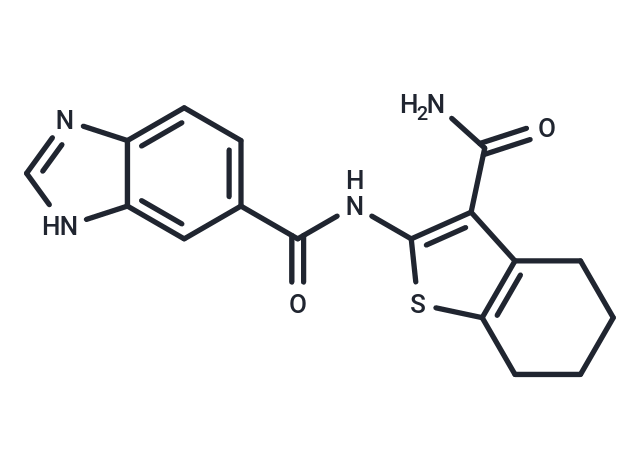
CRCD2
CAS No. 941185-83-7
CRCD2( —— )
Catalog No. M36926 CAS No. 941185-83-7
1H-Benzimidazole-6-carboxamide, N-[3-(aminocarbonyl)-4,5,6,7-tetrahydrobenzo[b]thien-2-yl]- may have antitumor activity.
Purity : >98% (HPLC)
 COA
Datasheet
HNMR
HPLC
MSDS
Handing Instructions
COA
Datasheet
HNMR
HPLC
MSDS
Handing Instructions
| Size | Price / USD | Stock | Quantity |
| 5MG | 164 | In Stock |


|
| 10MG | 265 | In Stock |
|
| 25MG | 531 | In Stock |
|
| 50MG | 807 | In Stock |
|
| 100MG | Get Quote | In Stock |
|
| 200MG | Get Quote | In Stock |
|
| 500MG | Get Quote | In Stock |
|
| 1G | Get Quote | In Stock |
|
Biological Information
-
Product NameCRCD2
-
NoteResearch use only, not for human use.
-
Brief Description1H-Benzimidazole-6-carboxamide, N-[3-(aminocarbonyl)-4,5,6,7-tetrahydrobenzo[b]thien-2-yl]- may have antitumor activity.
-
Description1H-Benzimidazole-6-carboxamide, N-[3-(aminocarbonyl)-4,5,6,7-tetrahydrobenzo[b]thien-2-yl]- may have antitumor activity.
-
In Vitro——
-
In Vivo——
-
Synonyms——
-
PathwayOthers
-
TargetOther Targets
-
RecptorOthers
-
Research Area——
-
Indication——
Chemical Information
-
CAS Number941185-83-7
-
Formula Weight340.4
-
Molecular FormulaC17H16N4O2S
-
Purity>98% (HPLC)
-
Solubility——
-
SMILESC(N)(=O)C=1C2=C(SC1NC(=O)C=3C=C4C(=CC3)N=CN4)CCCC2
-
Chemical Name——
Shipping & Storage Information
-
Storage(-20℃)
-
ShippingWith Ice Pack
-
Stability≥ 2 years
Reference
molnova catalog



related products
-
Tiagabine hydrochlor...
Tiagabine Hydrochloride is the hydrochloride salt form of tiagabine, a nipecotic acid derivative with anticonvulsant property.
-
GlyurallinB
Glyurallin B is a flavonoid, that can be isolated from licorice (Glycyrrhiza inflata and Glycyrrhiza uralensis). Glyurallin B shows ABTS+ radical scavenging activity and the inhibitory activity on lipid peroxidation, with EC50 values of 11.9 ± 0.58 μM and 15.3 ± 1.26 μM, respectivley.
-
[Met2]-Deltorphin
[Met2]-Deltorphin
