


 Cart
Cart
 sales@molnova.com


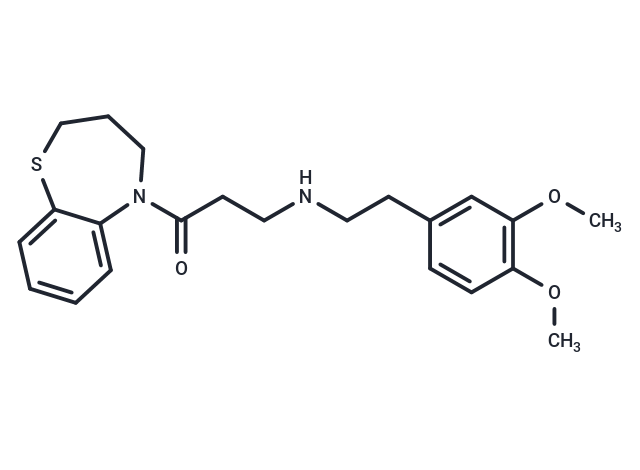
KT-362 free base
CAS No. 93392-97-3
KT-362 free base( —— )
Catalog No. M36550 CAS No. 93392-97-3
KT-362 is a calcium channel blocker with antihypertensive properties that can be used in the study of cardiovascular disease.
Purity : >98% (HPLC)
 COA
Datasheet
HNMR
HPLC
MSDS
Handing Instructions
COA
Datasheet
HNMR
HPLC
MSDS
Handing Instructions
| Size | Price / USD | Stock | Quantity |
| 5MG | 174 | In Stock |


|
| 10MG | 258 | In Stock |
|
| 25MG | 392 | In Stock |
|
| 50MG | 551 | In Stock |
|
| 100MG | 762 | In Stock |
|
| 200MG | 1014 | In Stock |
|
| 500MG | Get Quote | In Stock |
|
| 1G | Get Quote | In Stock |
|
Biological Information
-
Product NameKT-362 free base
-
NoteResearch use only, not for human use.
-
Brief DescriptionKT-362 is a calcium channel blocker with antihypertensive properties that can be used in the study of cardiovascular disease.
-
DescriptionKT-362 is a calcium channel blocker with antihypertensive properties that can be used in the study of cardiovascular disease.
-
In Vitro——
-
In Vivo——
-
Synonyms——
-
PathwayGPCR/G Protein
-
TargetCalcium Channel
-
RecptorCalcium Channel
-
Research Area——
-
Indication——
Chemical Information
-
CAS Number93392-97-3
-
Formula Weight400.53
-
Molecular FormulaC22H28N2O3S
-
Purity>98% (HPLC)
-
Solubility——
-
SMILESC(CCNCCC1=CC(OC)=C(OC)C=C1)(=O)N2C=3C(=CC=CC3)SCCC2
-
Chemical Name——
Shipping & Storage Information
-
Storage(-20℃)
-
ShippingWith Ice Pack
-
Stability≥ 2 years
Reference
molnova catalog



related products
-
Cronidipine
Cronidipine (LF 20254), a calcium channel antagonist, is used potentially for the treatment of hypertension and myocardia ischemia.
-
Amlodipine Besylate
Amlodipine Besylate is a long-acting calcium channel blocker.
-
alpha-L-Rhamnose
Addition of the Rhamnose-rich polysaccharide RROP-1 to normal human dermal fibroblasts (NHDFs) and human endothelial cells produced a dose-dependent stimulation of the calcium-signaling pathway inducing fast and transient increases in Ca2 influx and intracellular free Ca2 level.
