


 Cart
Cart
 sales@molnova.com


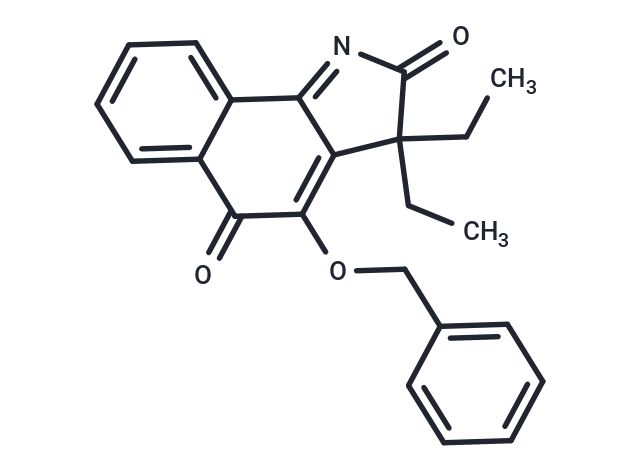
RIG012
CAS No. 2642218-43-5
RIG012( —— )
Catalog No. M36533 CAS No. 2642218-43-5
RIG012 is a potent RIG-I inhibitor with an IC50 of 0.71 μM (measured by NADH-coupled ATPase), and it inhibits the expression of IFN-β and ISG hRsad2.
Purity : >98% (HPLC)
 COA
Datasheet
HNMR
HPLC
MSDS
Handing Instructions
COA
Datasheet
HNMR
HPLC
MSDS
Handing Instructions
| Size | Price / USD | Stock | Quantity |
| 1 mL x 10 mM in DMSO | 169 | In Stock |


|
| 5MG | 152 | In Stock |
|
| 10MG | 228 | In Stock |
|
| 25MG | 388 | In Stock |
|
| 50MG | 522 | In Stock |
|
| 100MG | 745 | In Stock |
|
| 200MG | 995 | In Stock |
|
| 500MG | Get Quote | In Stock |
|
| 1G | Get Quote | In Stock |
|
Biological Information
-
Product NameRIG012
-
NoteResearch use only, not for human use.
-
Brief DescriptionRIG012 is a potent RIG-I inhibitor with an IC50 of 0.71 μM (measured by NADH-coupled ATPase), and it inhibits the expression of IFN-β and ISG hRsad2.
-
DescriptionRIG012 is a potent RIG-I inhibitor with an IC50 of 0.71 μM using the NADH-coupled ATPase assay. RIG012 inhibits IFN-β and ISG hRsad2 expression.
-
In Vitro——
-
In Vivo——
-
Synonyms——
-
PathwayOthers
-
TargetOther Targets
-
RecptorOthers
-
Research Area——
-
Indication——
Chemical Information
-
CAS Number2642218-43-5
-
Formula Weight359.42
-
Molecular FormulaC23H21NO3
-
Purity>98% (HPLC)
-
SolubilityIn Vitro:?DMSO : 33.33 mg/mL (92.73 mM; Ultrasonic )
-
SMILESC(C)C1(CC)C=2C(C=3C(C(=O)C2OCC4=CC=CC=C4)=CC=CC3)=NC1=O
-
Chemical Name——
Shipping & Storage Information
-
Storage(-20℃)
-
ShippingWith Ice Pack
-
Stability≥ 2 years
Reference



-
Schnurri-3 inhibitor...
Schnurri-3 inhibitor-1, a potent inhibitor of schnurri-3, is an essential regulator of bone formation in adults that can be used in osteoporosis research. Schnurri-3 inhibitor-1 can inhibit Shn3 with EF1alpha promoter in osteoblast cell line Shn3FFL (AC50 = 2.09 μM) .
-
3-Guanidinopropionic...
3-Guanidinopropionic acid is a creatine analog that alters skeletal muscle energy expenditure.?It reduces cellular ATP creatine and phosphocreatine levels and stimulates AMP-activated protein kinase (AMPK) activating PPARγ coactivator 1α (PGC-1α).
-
Ammonium formate
Formic acid is the simplest carboxylic acid. Formate is an intermediate in normal metabolism. It is responsible for both metabolic acidosis and disrupting mitochondrial electron transport and energy production by inhibiting cytochrome oxidase activity the terminal electron acceptor of the electron transport chain.
