


 Cart
Cart
 sales@molnova.com


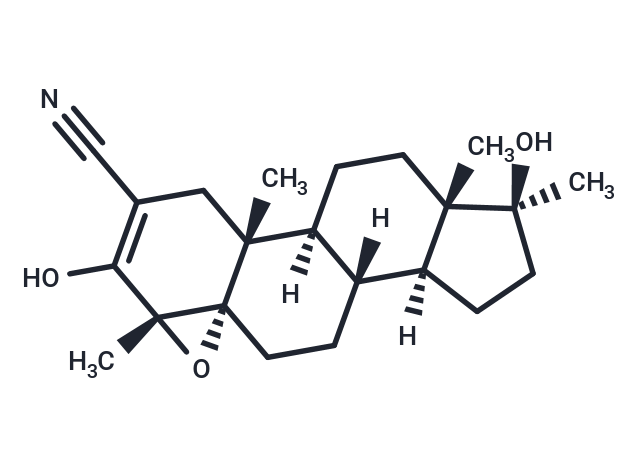
Epostane
CAS No. 80471-63-2
Epostane( —— )
Catalog No. M36263 CAS No. 80471-63-2
Epostane acts as an antiprogestogen and terminates pregnancy by inhibiting 3β-hydroxysteroid dehydrogenase and preventing the biosynthesis of progesterone and pregnenolone.
Purity : >98% (HPLC)
 COA
Datasheet
HNMR
HPLC
MSDS
Handing Instructions
COA
Datasheet
HNMR
HPLC
MSDS
Handing Instructions
| Size | Price / USD | Stock | Quantity |
| 5MG | 1226 | In Stock |


|
| 10MG | 1682 | In Stock |
|
| 25MG | 2499 | In Stock |
|
| 50MG | 3302 | In Stock |
|
| 100MG | 4455 | In Stock |
|
| 200MG | Get Quote | In Stock |
|
| 500MG | Get Quote | In Stock |
|
| 1G | Get Quote | In Stock |
|
Biological Information
-
Product NameEpostane
-
NoteResearch use only, not for human use.
-
Brief DescriptionEpostane acts as an antiprogestogen and terminates pregnancy by inhibiting 3β-hydroxysteroid dehydrogenase and preventing the biosynthesis of progesterone and pregnenolone.
-
DescriptionEpostane acts as an antiprogestogen and terminates pregnancy by inhibiting 3β-hydroxysteroid dehydrogenase and preventing the biosynthesis of progesterone and pregnenolone.
-
In Vitro——
-
In Vivo——
-
Synonyms——
-
PathwayMetabolic Enzyme/Protease
-
TargetDehydrogenase
-
RecptorDehydrogenase
-
Research Area——
-
Indication——
Chemical Information
-
CAS Number80471-63-2
-
Formula Weight357.49
-
Molecular FormulaC22H31NO3
-
Purity>98% (HPLC)
-
Solubility——
-
SMILESC[C@@]12[C@]3([C@](C)(O3)C(O)=C(C#N)C1)CC[C@@]4([C@@]2(CC[C@@]5(C)[C@]4(CC[C@]5(C)O)[H])[H])[H]
-
Chemical Name——
Shipping & Storage Information
-
Storage(-20℃)
-
ShippingWith Ice Pack
-
Stability≥ 2 years
Reference
molnova catalog



related products
-
DSM421
DSM421 (DSM-421) is a dihydrodehydrogenase inhibitor (DHODH) that is in preclinical development as a potential treatment option for malaria and has shown activity against field isolates of both P. falciparum and P. vivax.
-
(E/Z)-Ginkgolic acid...
(E/Z)-Ginkgolic Acid C17:2 (Ginkgolic Acid C17:2) is a natural product extracted from Ginkgo biloba that targets human dihydroorotate dehydrogenase (DHODH).
-
Manitimus
Manitimus (FK778) is an inhibitor of dehydroorotate dehydrogenase and an immunosuppressant with immunosuppressive and antiproliferative activity.
