


 Cart
Cart
 sales@molnova.com


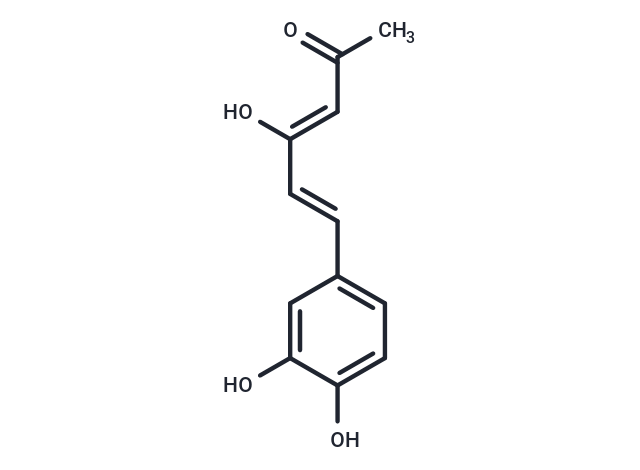
Hispolon
CAS No. 173933-40-9
Hispolon( —— )
Catalog No. M35937 CAS No. 173933-40-9
Hispolon is a polyphenol. Hispolon can be isolated from Phellinus linteus. Hispolon exhibits anticancer, antidiabetic, antiviral, hepatoprotective, antioxidant, and anti-inflammatory activities.
Purity : >98% (HPLC)
 COA
Datasheet
HNMR
HPLC
MSDS
Handing Instructions
COA
Datasheet
HNMR
HPLC
MSDS
Handing Instructions
| Size | Price / USD | Stock | Quantity |
| 5MG | 88 | In Stock |


|
| 10MG | 141 | In Stock |
|
| 25MG | 283 | In Stock |
|
| 50MG | 386 | In Stock |
|
| 100MG | Get Quote | In Stock |
|
| 200MG | Get Quote | In Stock |
|
| 500MG | Get Quote | In Stock |
|
| 1G | Get Quote | In Stock |
|
Biological Information
-
Product NameHispolon
-
NoteResearch use only, not for human use.
-
Brief DescriptionHispolon is a polyphenol. Hispolon can be isolated from Phellinus linteus. Hispolon exhibits anticancer, antidiabetic, antiviral, hepatoprotective, antioxidant, and anti-inflammatory activities.
-
DescriptionHispolon, a polyphenol, can be isolated from Phellinus linteus. Hispolon possesses anticancer, antidiabetic, antioxidant, antiviral, hepatoprotective, anti-diabetic, and anti-inflammatory activities.
-
In VitroHispolon (25 and 50 μM, 24-72 h) inhibits cell viability of U87MG cells.Hispolon (25 and 50 μM, 24, 48 h) induces G2/M cell cycle arrest and apoptosis in U87MG cells.Hispolon (25 and 50 μM, 2-8 h) decreases the expression of G1–S transition-related protein cyclin D4 but increases the expression of CDK inhibitor p21.Hispolon (25 and 50 μM, 24 h) inhibits the migration of U87MG cells.Cell Viability Assay Cell Line:U87MG cells Concentration:25 and 50 μM Incubation Time:24, 48, 72 h Result:Inhibited cell viability in a dose and time dependent way.Western Blot Analysis Cell Line:U87MG cells Concentration:25 and 50 μM Incubation Time:2, 4, 8 h Result:Decreased cyclin D4 level, and increased p21 level.
-
In VivoHispolon (2.5-10 mg/kg, i.p.) attenuates LPS-induced acute lung injury in mice.Hispolon (5 and 10 mg/kg, s.c.) reduces tumor growth in DBTRG xenograft mice.Animal Model:LPS-induced acute lung injury mice Dosage:2.5, 5 and 10 mg/kg Administration:Intraperitoneal injection (i.p.)Result:Alleviated the pathological effects in the LPS-challenged mouse.Reduced the W/D ratio in the lung and MPO activity.Decreased pro-Inflammatory cytokine production.Animal Model:DBTRG xenograft mice Dosage:5 and 10 mg/kg Administration:Subcutaneous injection (s.c.)Result:Reduced tumor volume (RTV).Inhibited GBM cell proliferation in vivo upon HE and ki-67 staining.
-
Synonyms——
-
PathwayOthers
-
TargetOther Targets
-
RecptorOthers
-
Research Area——
-
Indication——
Chemical Information
-
CAS Number173933-40-9
-
Formula Weight220.22
-
Molecular FormulaC12H12O4
-
Purity>98% (HPLC)
-
SolubilityIn Vitro:?DMSO : 125 mg/mL (567.61 mM; Ultrasonic (<70°C)
-
SMILESCC(=O)\C=C(/O)\C=C\c1ccc(O)c(O)c1
-
Chemical Name——
Shipping & Storage Information
-
Storage(-20℃)
-
ShippingWith Ice Pack
-
Stability≥ 2 years
Reference
1. Sarfraz A, et al. Hispolon: A natural polyphenol and emerging cancer killer by multiple cellular signaling pathways. Environ Res. 2020 Nov;190:110017.
molnova catalog



related products
-
DMPS-Na
DMPS-Na is an arsenicolytic agent with toxicity that can be used to study cell membranes.
-
HDL376
HDL376 is a scavenger receptor BI inhibitor.
-
Girards Reagent T
Girard's Reagent T (Trimethylacetohydrazideammonium Chloride) is a biochemical reagent. Girard's Reagent T under mild acid or alkaline conditions, reacts with aldehydes and ketones containing α-dicarbonyl functional groups to produce addition compounds which strongly absorb ultraviolet light.
