


 Cart
Cart
 sales@molnova.com


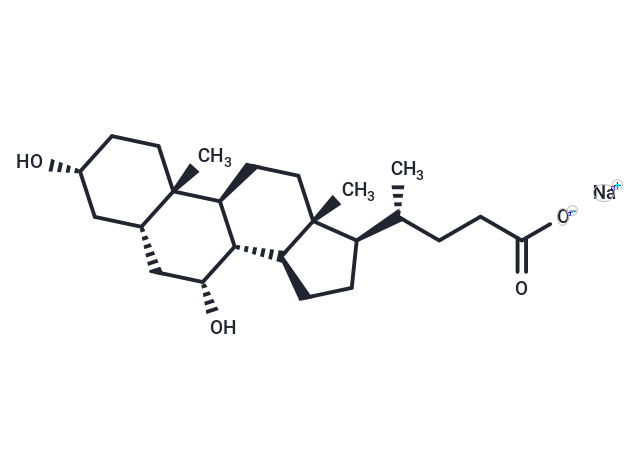
Chenodeoxycholic Acid sodium salt
CAS No. 2646-38-0
Chenodeoxycholic Acid sodium salt( —— )
Catalog No. M35851 CAS No. 2646-38-0
Chenodeoxycholic Acid sodium salt (CDCA sodium salt) is a bile acid in humans that activates the nuclear receptor FXR, rescues axonal degeneration of induced pluripotent stem cell-derived neurons in patients with spastic paraplegia type 5 and cerebral xanthomatosis, and can be used to study pancreatic necrosis.
Purity : >98% (HPLC)
 COA
Datasheet
HNMR
HPLC
MSDS
Handing Instructions
COA
Datasheet
HNMR
HPLC
MSDS
Handing Instructions
| Size | Price / USD | Stock | Quantity |
| 1 mL x 10 mM in DMSO | 33 | In Stock |


|
| 100MG | Get Quote | In Stock |
|
| 200MG | 28 | In Stock |
|
| 500MG | 40 | In Stock |
|
| 1G | 60 | In Stock |
|
Biological Information
-
Product NameChenodeoxycholic Acid sodium salt
-
NoteResearch use only, not for human use.
-
Brief DescriptionChenodeoxycholic Acid sodium salt (CDCA sodium salt) is a bile acid in humans that activates the nuclear receptor FXR, rescues axonal degeneration of induced pluripotent stem cell-derived neurons in patients with spastic paraplegia type 5 and cerebral xanthomatosis, and can be used to study pancreatic necrosis.
-
DescriptionChenodeoxycholic acid sodium is a hydrophobic primary bile acid that activates nuclear receptors (FXR) involved in cholesterol metabolism.
-
In VitroChenodeoxycholic acid sodium (CDCA) and Deoxycholic acid (DCA) both inhibit 11 beta HSD2 with IC50 values of 22 mM and 38 mM, respectively and causes cortisol-dependent nuclear translocation and increases transcriptionalactivity of mineralocorticoid receptor (MR). Chenodeoxycholic acid sodium is able to stimulate Ishikawa cell growth by inducing a significant increase in Cyclin D1 protein and mRNA expression through the activation of the membrane G protein-coupled receptor (TGR5)-dependent pathway. Chenodeoxycholic acid sodium (CDCA) induces LDL receptor mRNA levels approximately 4 fold and mRNA levels for HMG-CoA reductase and HMG-CoA synthase two fold in a cultured human hepatoblastoma cell line, Hep G2. Chenodeoxycholic acid sodium-induced Isc is inhibited (≥67%) by Bumetanide, BaCl2, and the cystic fibrosis transmembrane conductance regulator (CFTR) inhibitor CFTRinh-172. Chenodeoxycholic acid sodium-stimulated Isc is decreased 43% by the adenylate cyclase inhibitor MDL12330A and Chenodeoxycholic acid sodium increases intracellular cAMP concentration. Chenodeoxycholic acid sodium treatment activates C/EBPβ, as shown by increases in its phosphorylation, nuclear accumulation, and expression in HepG2 cells. Chenodeoxycholic acid sodium enhances luciferase gene transcription from the construct containing -1.65-kb GSTA2 promoter, which contains C/EBP response element (pGL-1651). Chenodeoxycholic acid sodium treatment activates AMP-activated protein kinase (AMPK), which leads to extracellular signal-regulated kinase 1/2 (ERK1/2) activation, as evidenced by the results of experiments using a dominant-negative mutant of AMPKα and chemical inhibitor.
-
In Vivo——
-
Synonyms——
-
PathwayMetabolic Enzyme/Protease
-
TargetFXR
-
RecptorFXR
-
Research Area——
-
Indication——
Chemical Information
-
CAS Number2646-38-0
-
Formula Weight414.55
-
Molecular FormulaC24H39NaO4
-
Purity>98% (HPLC)
-
Solubility——
-
SMILES[Na+].C[C@H](CCC([O-])=O)[C@H]1CC[C@H]2[C@@H]3[C@H](O)C[C@@H]4C[C@H](O)CC[C@]4(C)[C@H]3CC[C@]12C
-
Chemical Name——
Shipping & Storage Information
-
Storage(-20℃)
-
ShippingWith Ice Pack
-
Stability≥ 2 years
Reference
1. Stauffer AT, et al. Chenodeoxycholic acid and deoxycholic acid inhibit 11 beta-hydroxysteroid dehydrogenase type 2 and cause cortisol-induced transcriptional activation of the mineralocorticoid receptor. J Biol Chem. 2002 Jul 19;277(29):26286-92?
molnova catalog



related products
-
Altenusin
Altenusin is a natural nonsteroidal fungal metabolite, as a novel selective agonist of FXR with an EC50 value of 3.2 ± 0.2 μM.
-
Ursodeoxycholic acid...
Ursodeoxycholic acid sodium is a naturally occurring secondary bile acid with anti-inflammatory and cytoprotective activities. Ursodeoxycholic acid sodium acts as signaling molecule, exerting its effects by interacting with bile acid activated receptors,
-
Tauro-Obeticholic ac...
Tauro-Obeticholic acid is an active Obeticholic acid metabolite. Obeticholic acid is an orally bioavailable agonist of farnesoid-X receptor (FXR).
