


 Cart
Cart
 sales@molnova.com


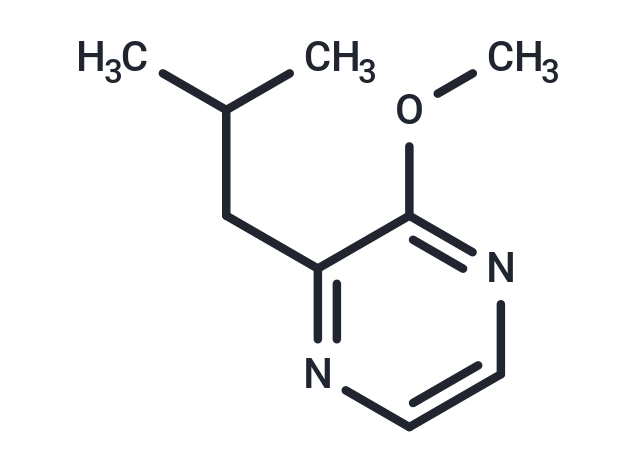
2-Isobutyl-3-methoxypyrazine
CAS No. 24683-00-9
2-Isobutyl-3-methoxypyrazine( —— )
Catalog No. M35837 CAS No. 24683-00-9
2-Isobutyl-3-methoxypyrazine (3-Isobutyl-2-methoxypyrazine) is a RIFM fragrance commonly used in the food and cosmetic industries.
Purity : >98% (HPLC)
 COA
Datasheet
HNMR
HPLC
MSDS
Handing Instructions
COA
Datasheet
HNMR
HPLC
MSDS
Handing Instructions
| Size | Price / USD | Stock | Quantity |
| 1 mL x 10 mM in DMSO | 28 | In Stock |


|
| 100MG | Get Quote | In Stock |
|
| 200MG | Get Quote | In Stock |
|
| 500MG | Get Quote | In Stock |
|
| 1G | 29 | In Stock |
|
Biological Information
-
Product Name2-Isobutyl-3-methoxypyrazine
-
NoteResearch use only, not for human use.
-
Brief Description2-Isobutyl-3-methoxypyrazine (3-Isobutyl-2-methoxypyrazine) is a RIFM fragrance commonly used in the food and cosmetic industries.
-
Description2-Isobutyl-3-methoxypyrazine is an aroma constituent in grapes andwines, green pepper and asparagus.
-
In Vitro——
-
In Vivo——
-
Synonyms——
-
PathwayOthers
-
TargetOther Targets
-
RecptorOthers
-
Research Area——
-
Indication——
Chemical Information
-
CAS Number24683-00-9
-
Formula Weight166.22
-
Molecular FormulaC9H14N2O
-
Purity>98% (HPLC)
-
SolubilityIn Vitro:?DMSO : 50 mg/mL (300.81 mM; Ultrasonic )
-
SMILESN=1C=CN=C(C1OC)CC(C)C
-
Chemical Name——
Shipping & Storage Information
-
Storage(-20℃)
-
ShippingWith Ice Pack
-
Stability≥ 2 years
Reference
1. Katja Suklje, et al. Classification of grape berries according to diameter and total soluble solids to study the effect of light and temperature on methoxypyrazine, glutathione, and hydroxycinnamate evolution during ripening of Sauvignon blanc (Vitis vini?
molnova catalog



related products
-
[Tyr0]-Urocortin (ra...
(Tyr0)-Urocortin, rat is a high-affinity agonist of corticotropin-releasing factor receptor type 1 (CRF-R1) and type 2 (CRF-R2). (Tyr0)-Urocortin, rat shows inhibitory binding constants (Ki) of 1-2 nM.
-
S-Y048
S-Y048 is an Oxoeicosanoid (OXE) receptor antagonist that inhibits allergen-induced eosinophil infiltration into the skin of experimentally sensitized rhesus monkeys to house dust mites and inhibits lung inflammation caused by aerosolized allergen challenge.
-
Anisatin
Anisatin, a toxic, insecticidally active component of Sikimi plant, is a potent GABA antagonist.
