


 Cart
Cart
 sales@molnova.com


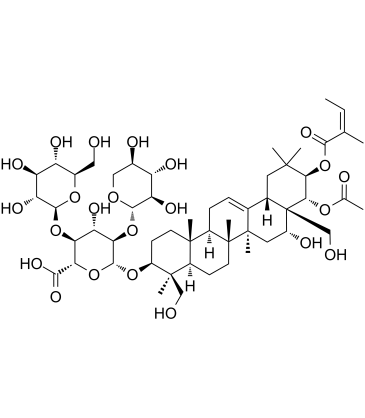
Escin Iib
CAS No. 158800-83-0
Escin Iib( —— )
Catalog No. M21791 CAS No. 158800-83-0
Escin IIb, isolated from horse chestnut, the seeds of Aesculus hippocastanum L., has positive effects on acute inflammation in animals.
Purity : >98% (HPLC)
 COA
Datasheet
HNMR
HPLC
MSDS
Handing Instructions
COA
Datasheet
HNMR
HPLC
MSDS
Handing Instructions
| Size | Price / USD | Stock | Quantity |
| 5MG | 187 | In Stock |


|
| 10MG | 276 | In Stock |
|
| 25MG | 465 | In Stock |
|
| 50MG | 663 | In Stock |
|
| 100MG | 918 | In Stock |
|
| 200MG | Get Quote | In Stock |
|
| 500MG | Get Quote | In Stock |
|
| 1G | Get Quote | In Stock |
|
Biological Information
-
Product NameEscin Iib
-
NoteResearch use only, not for human use.
-
Brief DescriptionEscin IIb, isolated from horse chestnut, the seeds of Aesculus hippocastanum L., has positive effects on acute inflammation in animals.
-
DescriptionEscin IIb, isolated from horse chestnut, the seeds of Aesculus hippocastanum L., has positive effects on acute inflammation in animals. Escin IIb showed potent protective effects against ethanol-induced gastric mucosal lesions.
-
In Vitro——
-
In VivoEscins Ia, Ib, IIa, and IIb (50-200 mg/kg) inhibit the increase of vascular permeability induced by both acetic acid in mice and histamine in rats. Escins Ib, IIa, and IIb (50-200 mg/kg) also inhibit that induced by serotonin in rats, but escin Ia didn't. Escins Ia, Ib, IIa, and IIb (200 mg/kg) inhibit the hind paw edema induced by carrageenin at the first phase in rats. Escin Ia (200 mg/kg) and escins Ib, IIa, and IIb (50-200 mg/kg) inhibit the scratching behavior induced by compound 48/80 in mice, but escin Ia was weakest.Escin IIb (10-50 mg/kg; p.o.) potently inhibits ethanol-induced gastric mucosal lesions. Animal Model:Male Sprague–Dawley rats (Ethanol-induced gastric mucosal lesions in rats)Dosage:P.o.Administration:10-50 mg/kg Result:Showed a potent protective effect against ethanol-induced gastric lesions in rats.
-
Synonyms——
-
PathwayOthers
-
TargetOther Targets
-
Recptor——
-
Research Area——
-
Indication——
Chemical Information
-
CAS Number158800-83-0
-
Formula Weight1101.23
-
Molecular FormulaC??H??O??
-
Purity>98% (HPLC)
-
Solubility——
-
SMILESOC[C@]12[C@](CC(C)(C)[C@@H](OC(/C(C)=C\C)=O)[C@@H]2OC(C)=O)([H])C3=CC[C@@]([C@@]4([C@@]([C@@](CO)([C@@H](O[C@H]5[C@H](O[C@H]6[C@H](O)[C@@H](O)[C@H](O)CO6)[C@@H](O)[C@H](O[C@@H]7O[C@H](CO)[C@@H](O)[C@H](O)[C@H]7O)[C@@H](C(O)=O)O5)CC4)C)([H])CC8)C)([H])[C@]8(C)[C@]3(C)C[C@H]1O
-
Chemical Name——
Shipping & Storage Information
-
Storage(-20℃)
-
ShippingWith Ice Pack
-
Stability≥ 2 years
Reference
1. Matsuda H, et al. Effects of escins Ia, Ib, IIa, and IIb from horse chestnut, the seeds of Aesculus hippocastanum L., on acute inflammation in animals. Biol Pharm Bull. 1997;20(10):1092-1095.
2. Matsuda H, et al. Gastroprotections of escins Ia, Ib, IIa, and IIb on ethanol-induced gastric mucosal lesions in rats. Eur J Pharmacol. 1999;373(1):63-70.
molnova catalog



related products
-
N-trans-Caffeoy-L-do...
cyt-PTPε inhibitor 1 is a potent cytosolic protein tyrosine phosphatase epsilon (cyt-PTPε) inhibitor, which binds to the catalytic domain of cyt-PTPε and blocks c-Src activation Chemical), and has anti-bone breaking activity.
-
Benzoylphenylalanine
Benzoylphenylalanine can be used as a photoaffinity peptide inactivator.
-
Cirsiliol
Cirsiliol is a selective inhibitor of 5-lipoxygenase and a competitive low-affinity ligand of benzodiazepine receptors.
