


 Cart
Cart
 sales@molnova.com


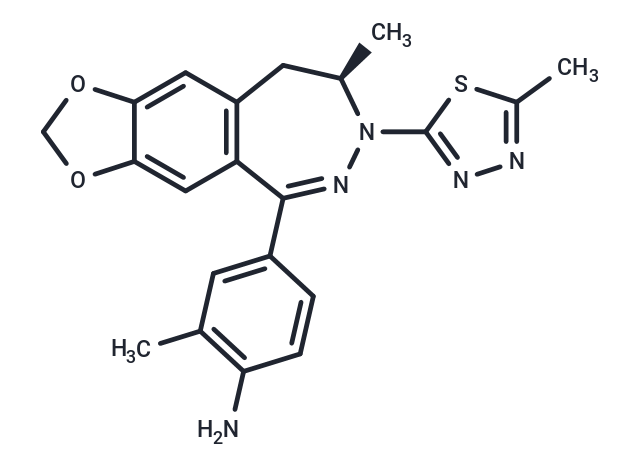
BDZ-g
CAS No. 732278-52-3
BDZ-g( —— )
Catalog No. M35613 CAS No. 732278-52-3
BDZ-g is a potent and selective antagonist of AMPA receptor. BDZ-g can be used for the research of various neurological disorders involving excessive activity of AMPA receptors.
Purity : >98% (HPLC)
 COA
Datasheet
HNMR
HPLC
MSDS
Handing Instructions
COA
Datasheet
HNMR
HPLC
MSDS
Handing Instructions
| Size | Price / USD | Stock | Quantity |
| 1 mL x 10 mM in DMSO | 117 | In Stock |


|
| 5MG | 107 | In Stock |
|
| 10MG | 157 | In Stock |
|
| 25MG | 236 | In Stock |
|
| 50MG | 324 | In Stock |
|
| 100MG | Get Quote | In Stock |
|
| 200MG | Get Quote | In Stock |
|
| 500MG | Get Quote | In Stock |
|
| 1G | Get Quote | In Stock |
|
Biological Information
-
Product NameBDZ-g
-
NoteResearch use only, not for human use.
-
Brief DescriptionBDZ-g is a potent and selective antagonist of AMPA receptor. BDZ-g can be used for the research of various neurological disorders involving excessive activity of AMPA receptors.
-
DescriptionBDZ-g is a potent, selective antagonist of AMPA receptor. BDZ-g has the potential for the research of various neurological disorders involving excessive activity of AMPA receptors.
-
In Vitro——
-
In Vivo——
-
Synonyms——
-
PathwayMembrane Transporter/Ion Channel
-
TargetiGluR
-
RecptoriGluR
-
Research Area——
-
Indication——
Chemical Information
-
CAS Number732278-52-3
-
Formula Weight407.49
-
Molecular FormulaC21H21N5O2S
-
Purity>98% (HPLC)
-
Solubility——
-
SMILESCC=1C=C(C=2C3=C(C=C4C(=C3)OCO4)C[C@@H](C)N(N2)C=5SC(C)=NN5)C=CC1N
-
Chemical Name——
Shipping & Storage Information
-
Storage(-20℃)
-
ShippingWith Ice Pack
-
Stability≥ 2 years
Reference
1. Wang C, et al. Mechanism and site of inhibition of AMPA receptors: pairing a thiadiazole with a 2,3-benzodiazepine scaffold. ACS Chem Neurosci. 2014;5(2):138-147.?
molnova catalog



related products
-
Isomangiferin
Isomangiferin is the major tetracyclic oxindole alkaloid components of Uncaira species, inhibits NMDA receptor with IC50 of 43.2 uM.
-
Conantokin G
GluN2B (formally NR2B) selective, competitive antagonist of the NMDA receptor. Blocks NMDA-evoked current in mouse cortical neurons (IC50 = 480 nM); also inhibits NMDA-evoked responses in oocytes expressing GluN2B (formally NR2B), but not GluN2A (formally NR2A), subunits (IC50 ~300 nM). Exhibits neuroprotective properties in vivo and in vitro.
-
Dynorphin A 1-10
Dynorphin A (1-10), an endogenous opioid neuropeptide, binds to extracellular loop 2 of the κ-opioid receptor. Dynorphin A (1-10) also blocks NMDA-activated current with an IC50 of 42.0 μM.
